South West WA Wildflowers: Walks, Orchids & Itinerary
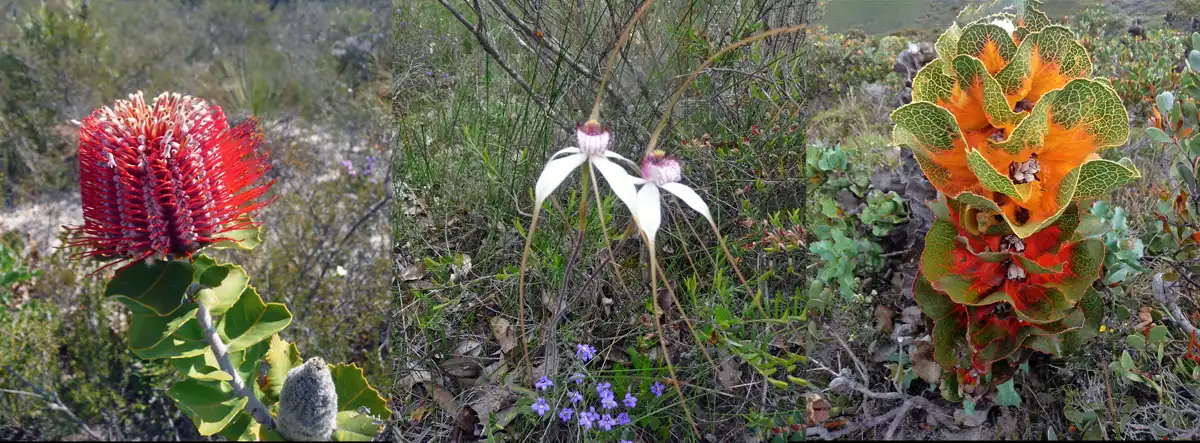
We explored South-West Western Australia on a relaxed three-week motorhome journey, starting in Perth and following the coast south before turning east toward Albany and the remote beauty of Fitzgerald River National Park. It was the perfect way to travel — unhurried, flexible, and close to nature.
We stopped at secluded campsites along the way, spending our nights surrounded by wildlife. The trails always took longer than expected; we couldn’t help but stop to photograph the stunning native plants and wild orchids, many of which we’d never seen before.After a few fantastic days at Quaalup Homestead Wilderness Retreat on the border of the Fitzgerald River National Park, one of Western Australia’s richest wildflower regions, we began our return journey inland.
The Stirling Range was a highlight—a true mecca for wildflower lovers and bushwalkers, with dramatic landscapes and an incredible diversity of flowering plants. Our final stop was Kojonup, a lesser-known but outstanding destination for wild orchids. Here, we discovered delicate spider orchids and other native species growing quietly beside bush tracks and nature reserves.
This motorhome journey through south-west WA was unforgettable — a celebration of wildflowers, peaceful walks, and the remarkable botanical diversity of Western Australia.
Table of contents
- Dryandra
- Alexandra Bridge
- Walpole-Nornalup National Park
- West Cape Howe National Park – Walks & Wildflowers
- Exploring Albany – Walks & Wildflowers
- Point Ann, Whales & Wildflowers
- Quaalup Homestead: Staying in Fitzgerald River National Park
- Porongurup – Twin Creeks Conservation Reserve
- Stirling Range National Park
- Kojonup a Wildflower Paradies
- Back to Perth – Conclusion
Dryandra Woodland and Wellington National Park
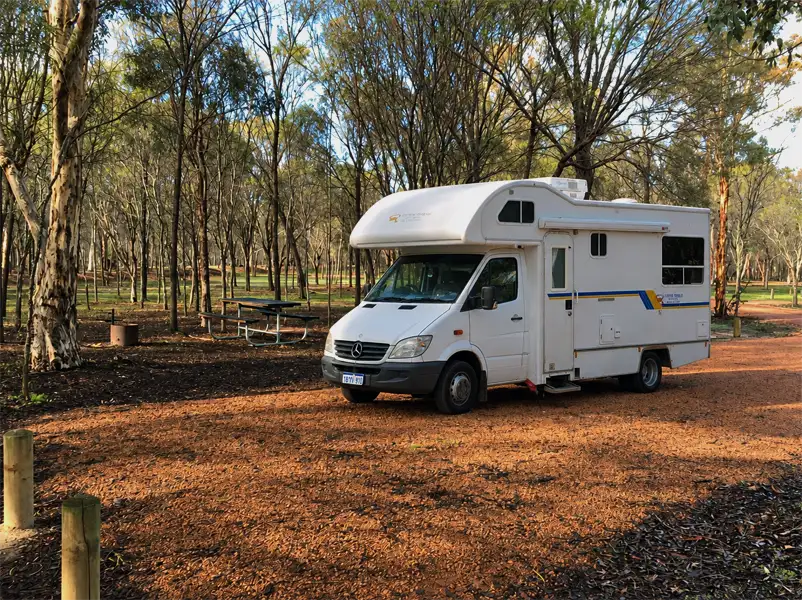
In Perth, we picked up our motorhome — our transport and accommodation for the next three weeks. It was a bit like us: an older model, sometimes a little tired around the edges, but inside, very comfortable.
We drove for only a few hours to Dryandra Woodland National Park, arriving early enough to settle in and familiarise ourselves with all the facilities, both inside the motorhome and outside.
The campsite was small, very secluded, and almost empty. Sitting quietly outside in the evening with a glass of red wine, we hoped to spot some of Western Australia’s wildlife, especially the elusive numbat.
It was a wonderfully peaceful and almost romantic evening in the bush. The numbats kept themselves hidden, though — we saw only a few kangaroos and wallabies. Even without the wildlife we had hoped for, staying there was one of those simple experiences that made the journey memorable.
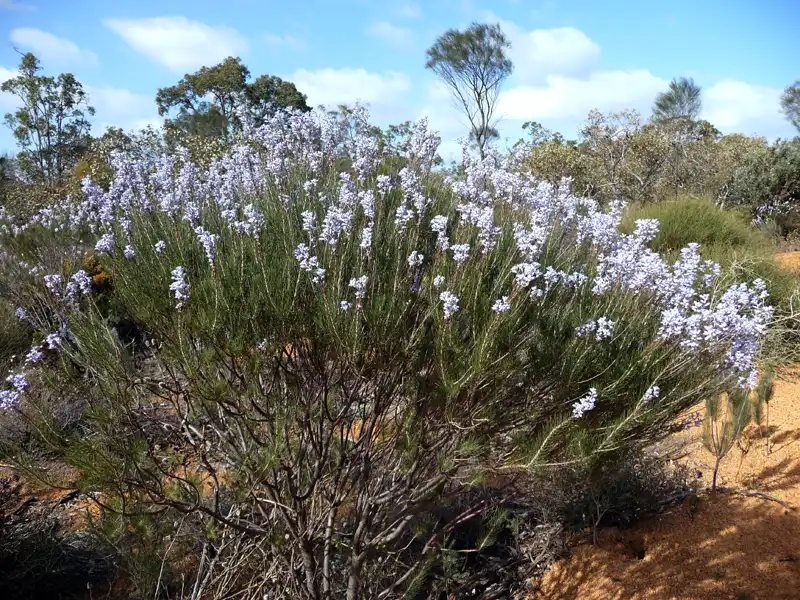
Common Smokebush (Conospermum stoechadis), Dryandra Woodland National Park
We didn’t want to spend hours behind the wheel on this trip, so we decided that about three hours of driving a day was our limit. Our next destination was Wellington National Park, and it turned out to be another wonderful stop.
We loved camping among the majestic jarrah and marri forests. The tall native trees surrounded us, and the fresh, distinctive smell of the bush made the whole place feel wonderfully Australian.
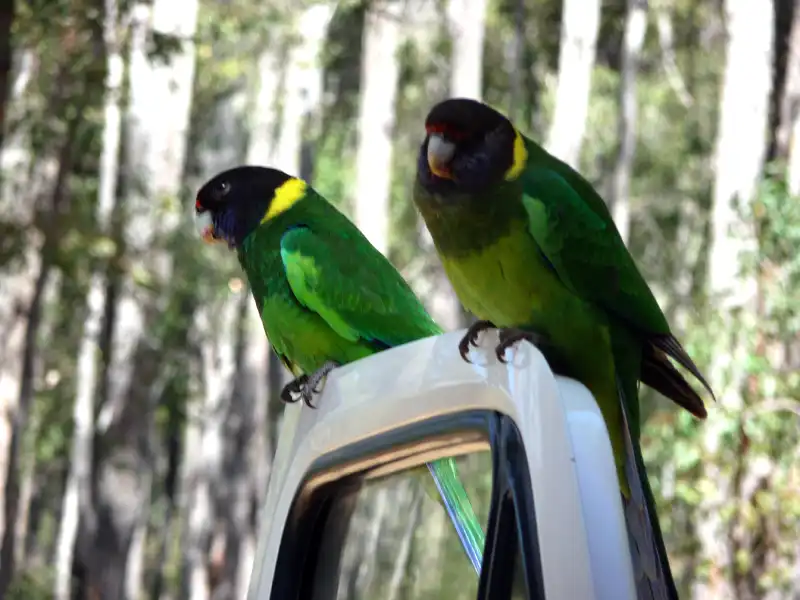
The campground was much busier than our previous stop, but the facilities were also considerably better. We soon made some new friends — a group of colourful Ringneck Parrots that regularly came to visit our campsite.
The following day, we set off on the Sika Trail, a three-hour walk through the forest. The trail offered lovely views over the Collie River Valley and Wellington Dam, with plenty of time to enjoy the peaceful forest along the way.
Another great day on our journey through Western Australia — and another reminder that we didn’t need to travel far to find beautiful places.
Camping at Alexandra Bridge on the Blackwood River
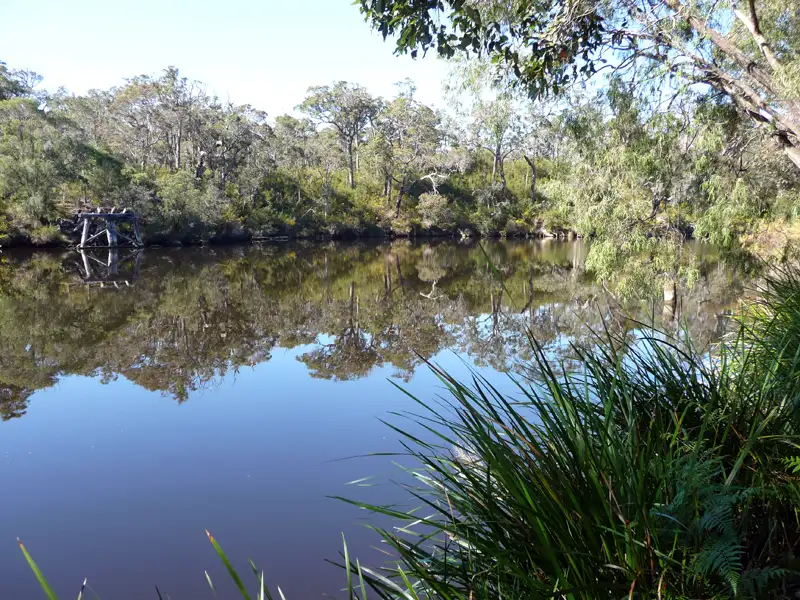
Our next stop was Alexandra Bridge Campground, a peaceful riverside campsite on the banks of the Blackwood River, about 35 km from Margaret River.
We arrived on a Sunday, and the campground was already very busy and almost fully booked. Luckily, we managed to find a spot for our motorhome, just outside the main camping area, with lovely views of the river and surrounded by beautiful wildflowers.
We paid our camping fee, and the kind ranger allowed us to stay, even though the campground was nearly full. We were grateful for his generosity!
The facilities were very basic, with no hot water, electricity or camp kitchen, but there were flushing toilets and cold outdoor showers. For us, that wasn’t a problem. We had everything we needed in our cosy motorhome and thoroughly enjoyed our stay beside the river.
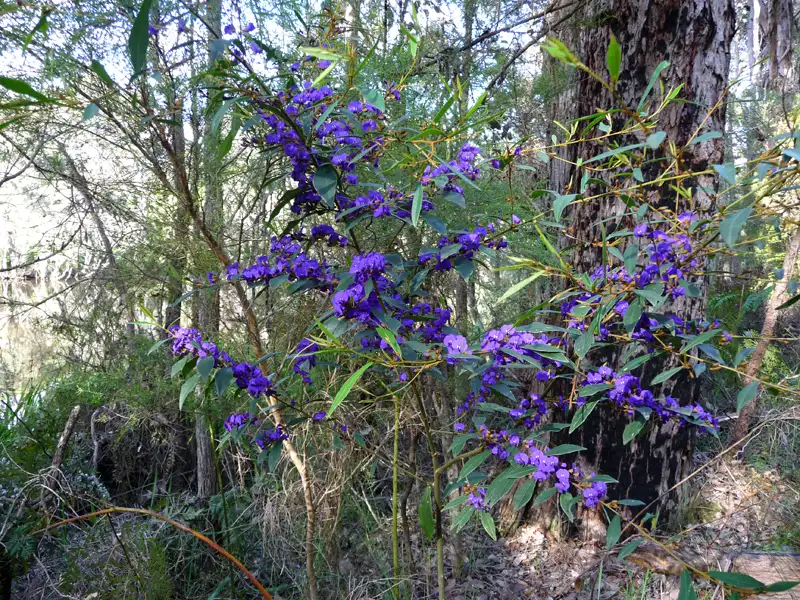
We walked beneath the tall peppermint gum trees along the Blackwood River and spotted many Native Wisteria (Hardenbergia comptoniana) in flower. We took so many photos that we now can’t decide which one we like best!
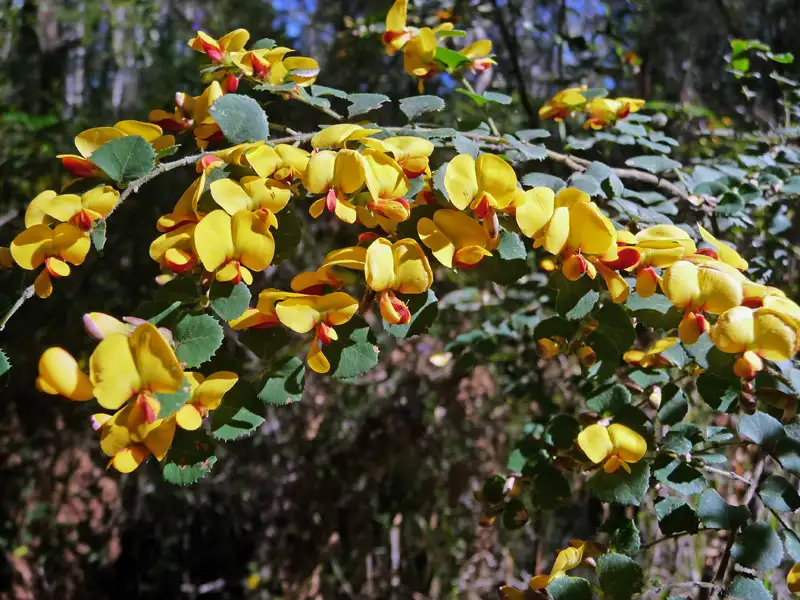
Water Bush , a native shrub in the pea family
Walpole-Nornalup National Park and the Valley of the Giants
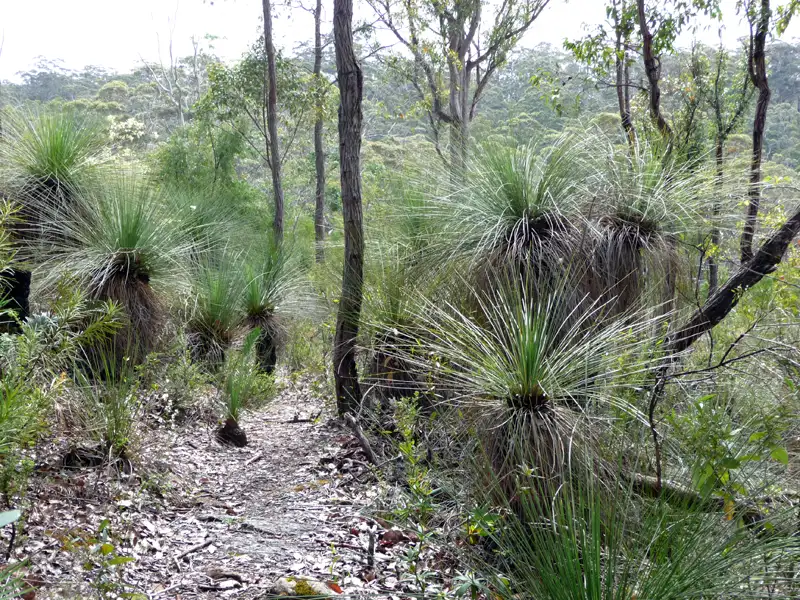
After another two hours’ drive south, we arrived at Shannon National Park, a fabulous place to hike and explore one of Western Australia’s spectacular karri forests. Surrounded by towering karri trees and colourful wildflowers, it was another highlight of our journey through the south-west.
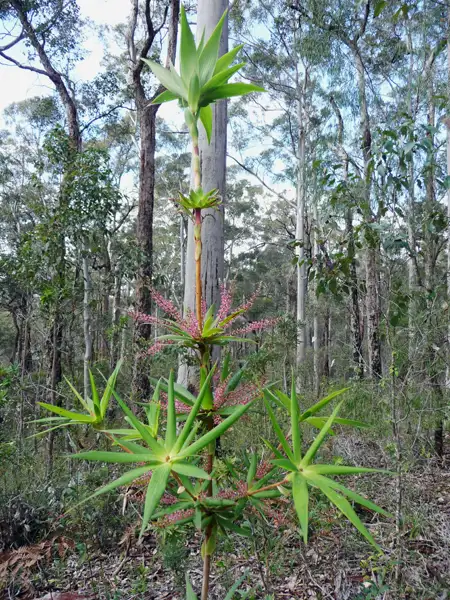
The most fascinating plant we found in the park was the Tassel Flower (Leucopogon verticillatus), a bamboo-like shrub that can grow up to 1.5 metres tall. Its delicate pink flowers stood out beautifully among the karri and jarrah forests of Western Australia.
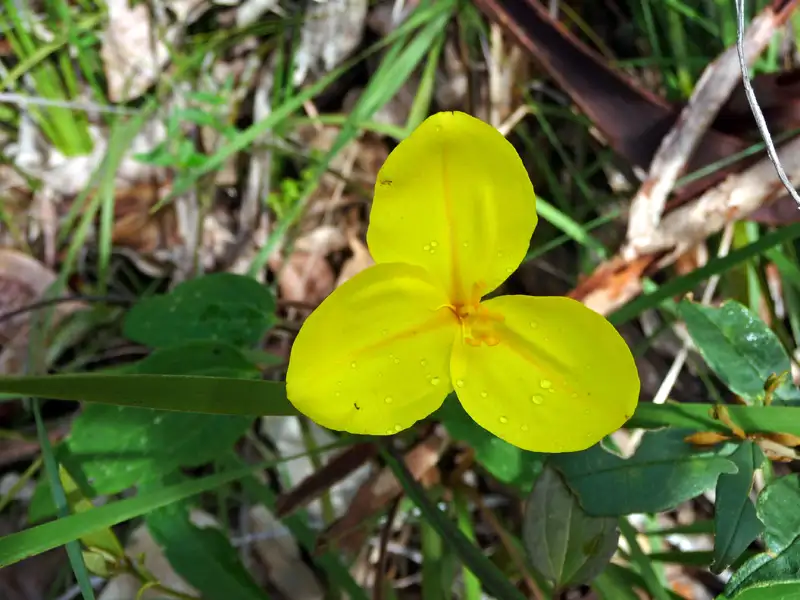
The Yellow Flag (Patersonia umbrosa) is named for its bright yellow flowers and is quite common throughout Western Australia.
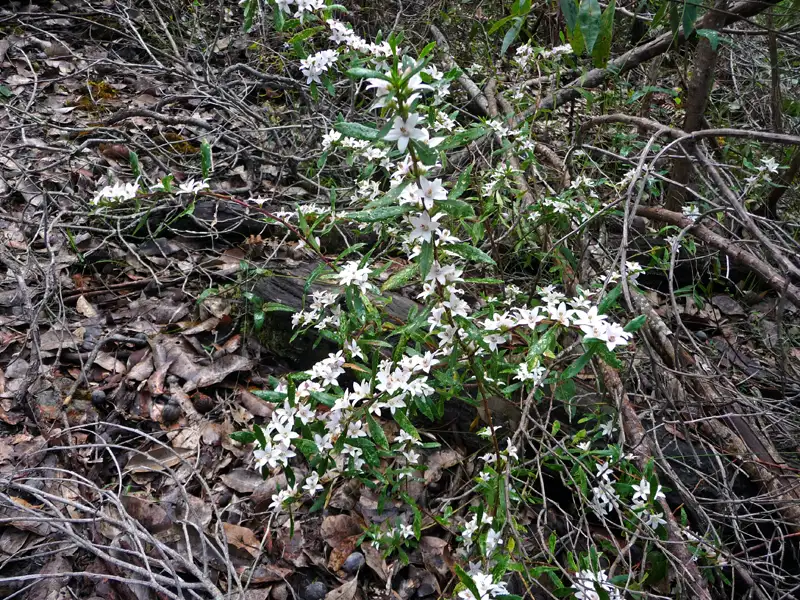
Swamp Waxflower, or Bush Crowea (Crowea angustifolia), is a native shrub endemic to the damp understories and forest valleys of south-west Western Australia.
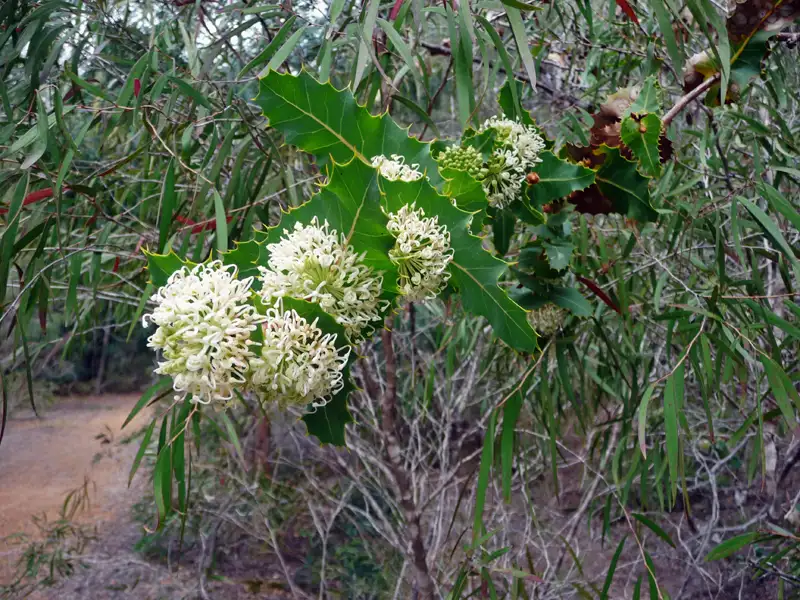
We finished our visit to Shannon National Park with one more beautiful wildflower, the Prickly Hakea (Hakea amplexicaulis). It was a lovely way to end our time in the park before getting back on the road.
Our next destination was Walpole, where we were looking forward to exploring the spectacular Valley of the Giants and its enormous old-growth trees.
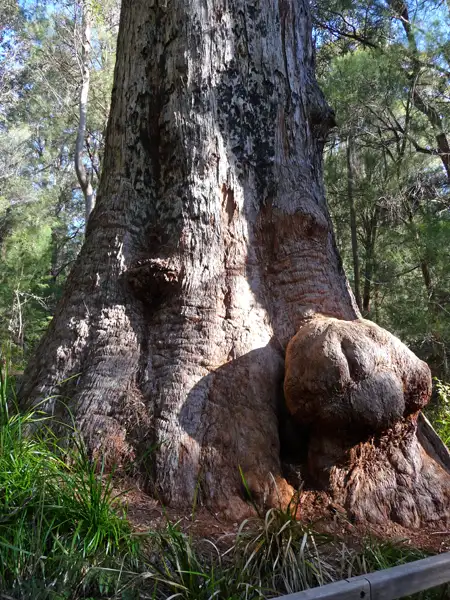
The Red Tingle trees are one of the special sights of the Walpole region. They grow almost exclusively in the Walpole-Nornalup National Park, with their enormous swollen bases, or burls, giving them a remarkable appearance. Some trees reach up to 60 metres high and can live for 400 years or more. Standing among these ancient giants, we felt surrounded by a forest that has been here for centuries.
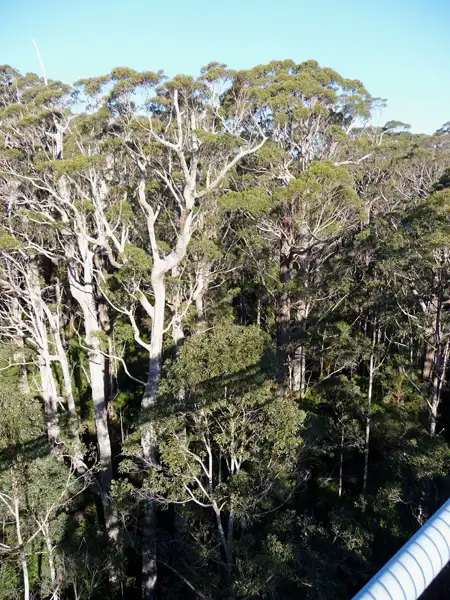
Because it was a must-see, we did the Valley of the Giants Tree Top Walk, an easy walk about 40 metres above the ground. We have experienced other tree-top walks around Australia, and we certainly admire the construction and engineering that make them possible. But for us, walking beneath these magnificent giants and looking up into their enormous crowns was even more impressive. It was a wonderful way to experience the forest from below.
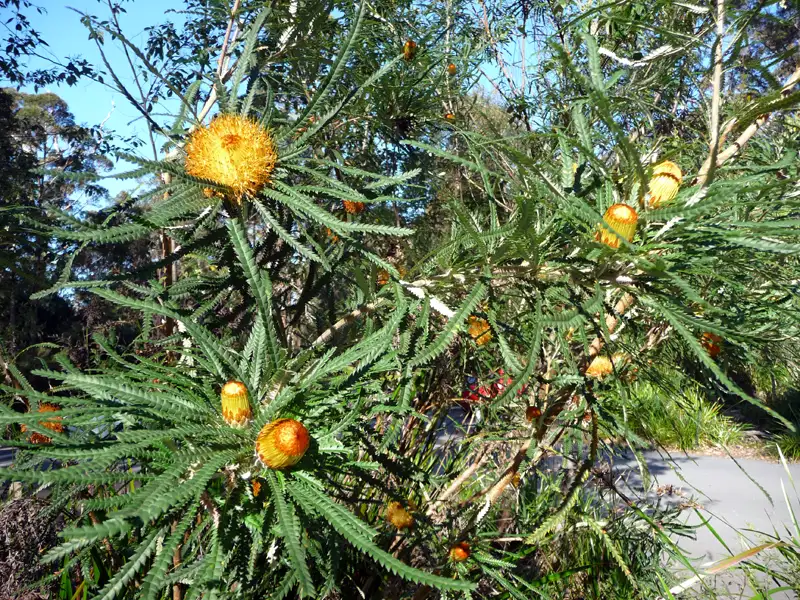
Among all these giant trees, we spotted a beautiful Showy Dryandra (Banksia formosa), its striking flowers standing out against the ancient forest.
West Cape Howe National Park – Walks & Wildflowers
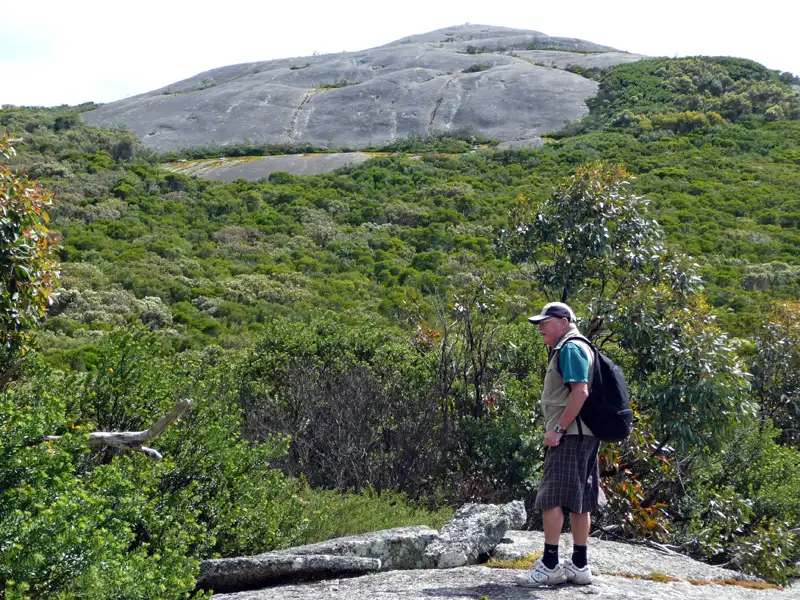
We spent a day hiking in West Cape Howe National Park, following part of the Bibbulmun Track. We didn’t make it all the way down to the beach, as we were too busy climbing over the large granite boulders and stopping to admire and photograph the fantastic wildflowers. With so much to see along the trail, our progress was rather slow—but that was exactly how we liked it.
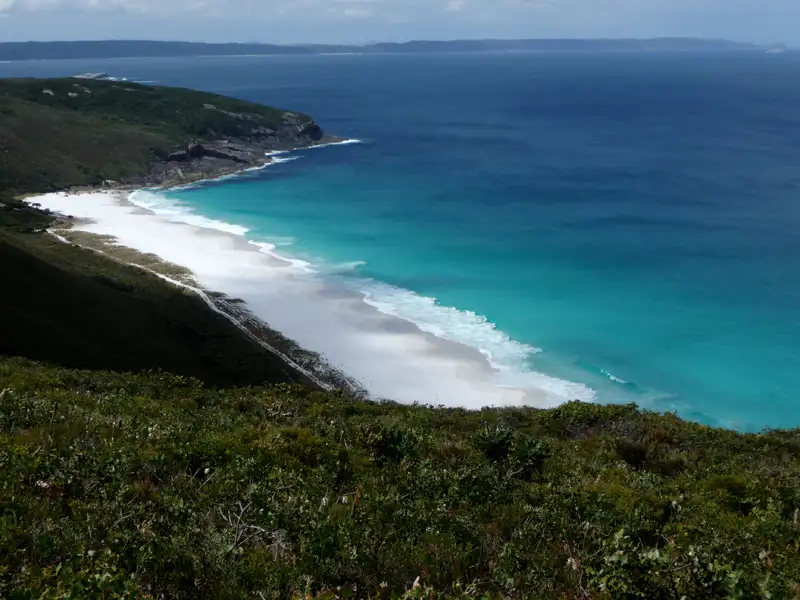
It wasn’t only the fantastic wildflowers that made this part of the journey special. From time to time, we were rewarded with wonderful views of the West Cape Howe coastline, with its rugged cliffs and long, empty white beaches.
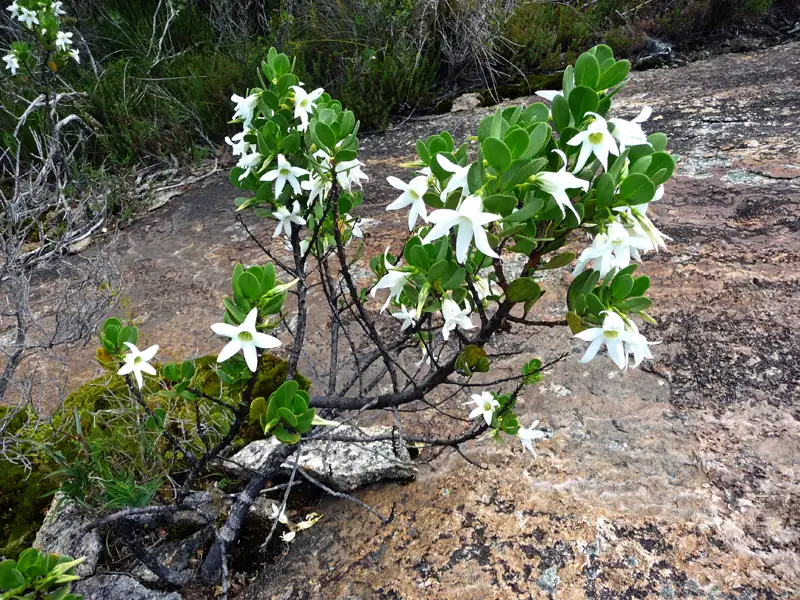
The Sticky Tailflower (Anthocercis viscosa) grows directly on elevated granite outcrops and rocky headlands. The shrub can grow up to 3 metres tall, but along our track we saw only much smaller plants during our walk.
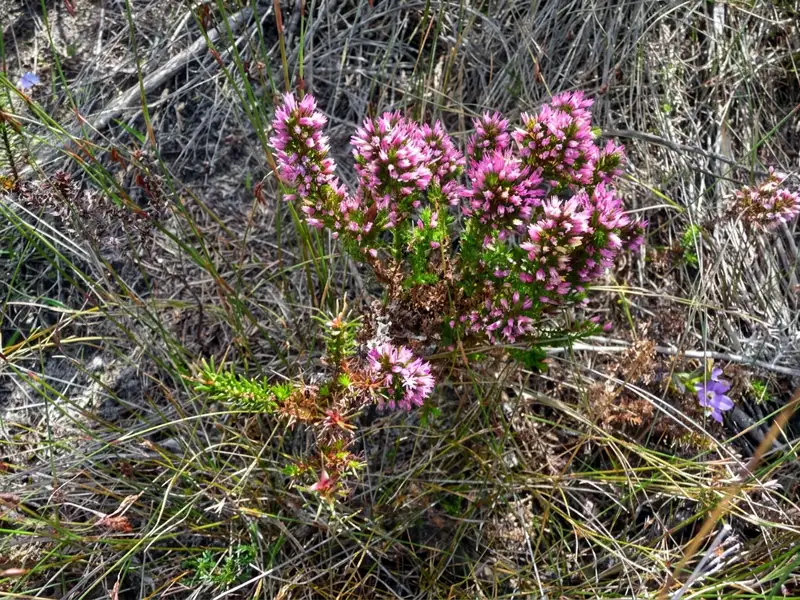
Another interesting plant we found along the trail was Foxtails (Andersonia caerulea), a member of the Ericaceae family. This small shrub can grow anywhere from just 5 cm to about 1 metre tall. Its distinctive flowers made it another fascinating discovery along our walk.
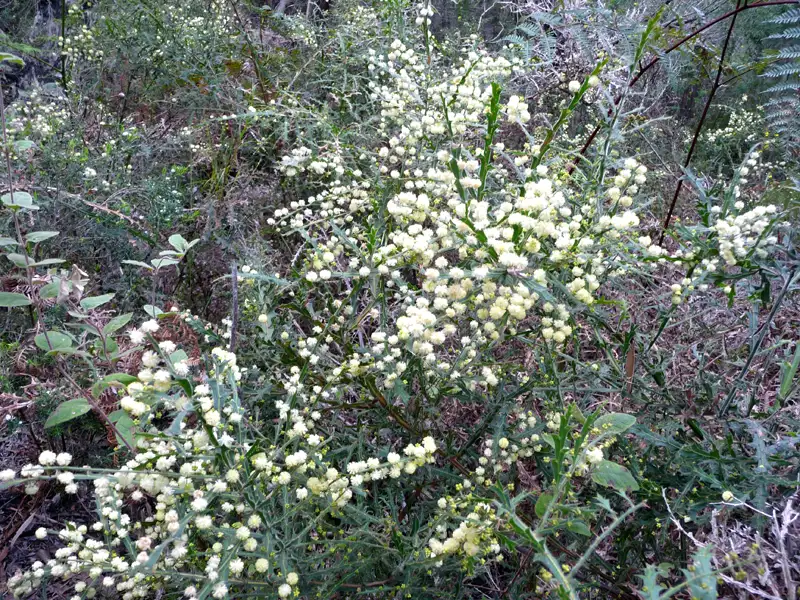
Among the granite outcrops of south-west Western Australia, we also came across Winged Wattle (Acacia alata), another beautiful native plant of the region.
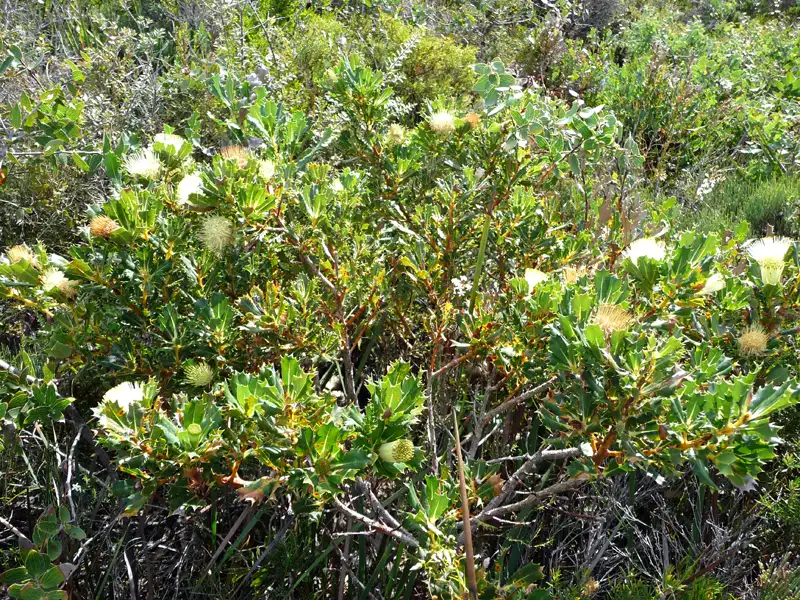
While hiking the Bibbulmun Track near West Cape Howe, we spotted a pretty, prickly shrub, the Parrot Bush (Banksia sessilis). We hadn’t seen this one before, and its unusual flowers and spiky leaves immediately caught our attention.

This attractive plant, with its orange-yellow pea flowers, is the Heart-leaf Poison (Gastrolobium grandiflorum), also known as Poisonous Pea. It is considered one of the most toxic members of the Gastrolobium family. If eaten by livestock, the plant can cause rapid poisoning and death.
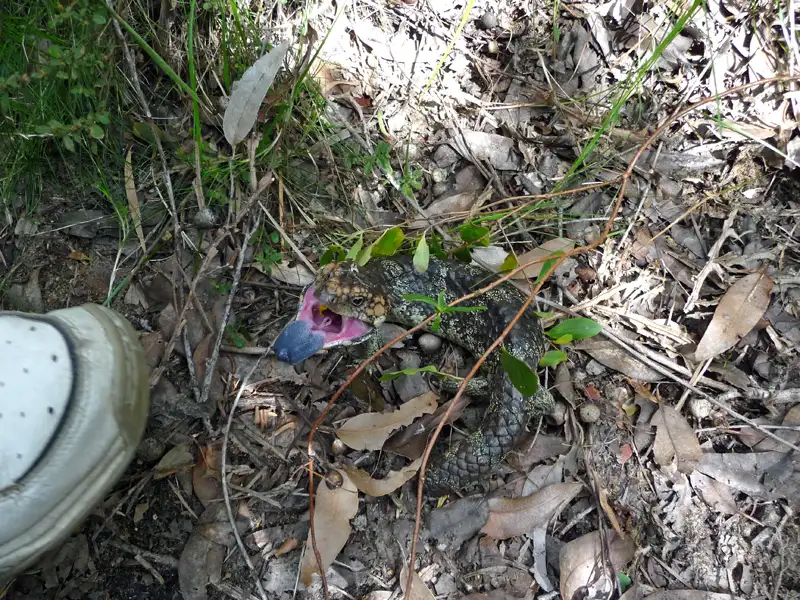
One reason we were late on our hike along the Bibbulmun Track near West Cape Howe was that we had to stop for a while when a monster appeared to be ready to swallow me! Its name? Blue-tongue Lizard.
I quickly took out my phone and Googled it. Fortunately, I discovered that this “monster” grows to only about 60 cm! Reassured, we continued our hike.
Exploring Albany – Walks & Wildflowers
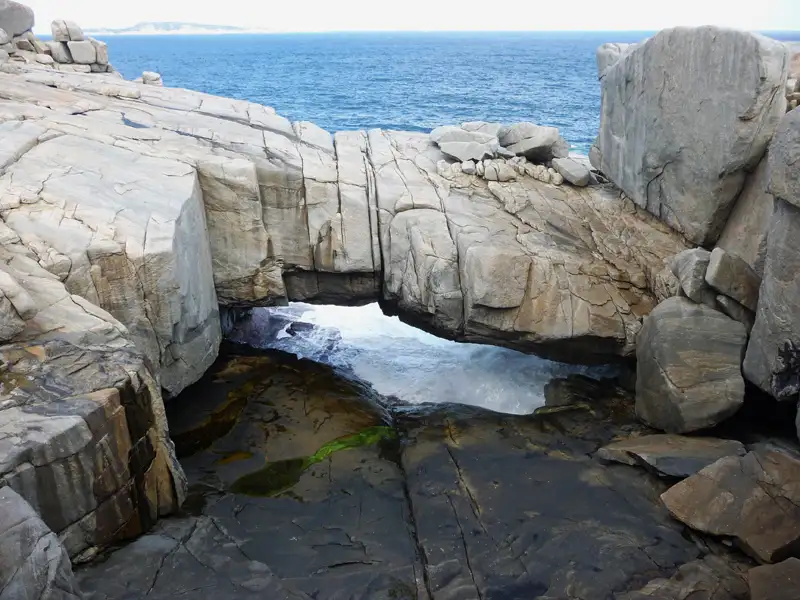
From there, we explored the very nice town of Albany and the surrounding area. Our first stop was The Gap and Natural Bridge, part of Torndirrup National Park, just an easy 20-minute drive from Albany.
The Gap and Natural Bridge offer spectacular views of the Southern Ocean and one of Australia’s most exposed coastlines. We loved the dramatic scenery, and for us, it was definitely worth the entry and parking fees.
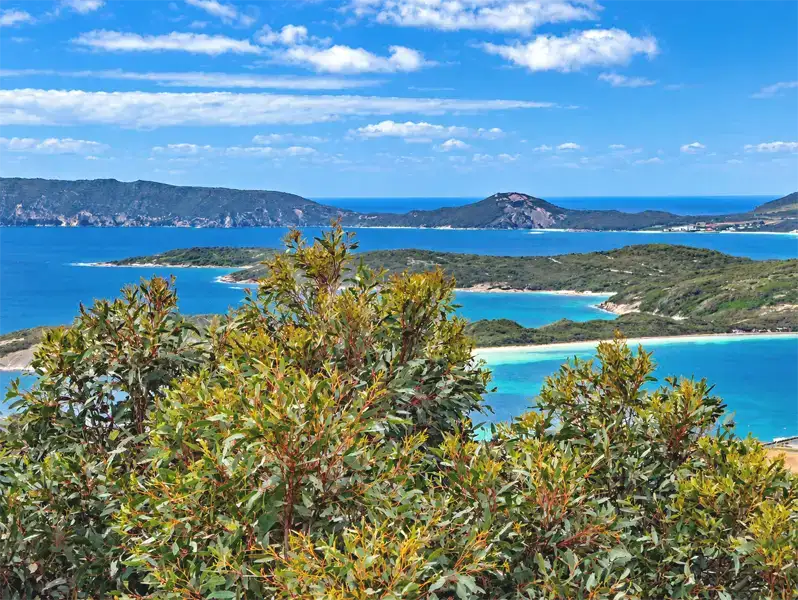
We had a wonderful 4-kilometre walk up to Quarantine Hill, where Western Australia’s first permanent quarantine facility was established. The walk was well worth it, especially when we reached the top and were rewarded with spectacular 360-degree views over Albany, the surrounding waters, and King George Sound.

A really enjoyable walk we discovered in Albany was the Albany Windfarm Loop. It is an easy and scenic walk along the high cliffs overlooking the Southern Ocean, with beautiful views and plenty of wildflowers along the track.
Many people may not particularly like wind turbines, but we found them surprisingly beautiful. Standing high on the cliffs, the huge turbines looked almost like artistic sculptures, their blades slowly turning against the sky and sea. For us, they added something special to the landscape rather than spoiling it.
The Windfarm Loop itself is relatively short, but the walk can be extended by joining a section of the Bibbulmun Track, making it possible to explore more of this spectacular coastal landscape.
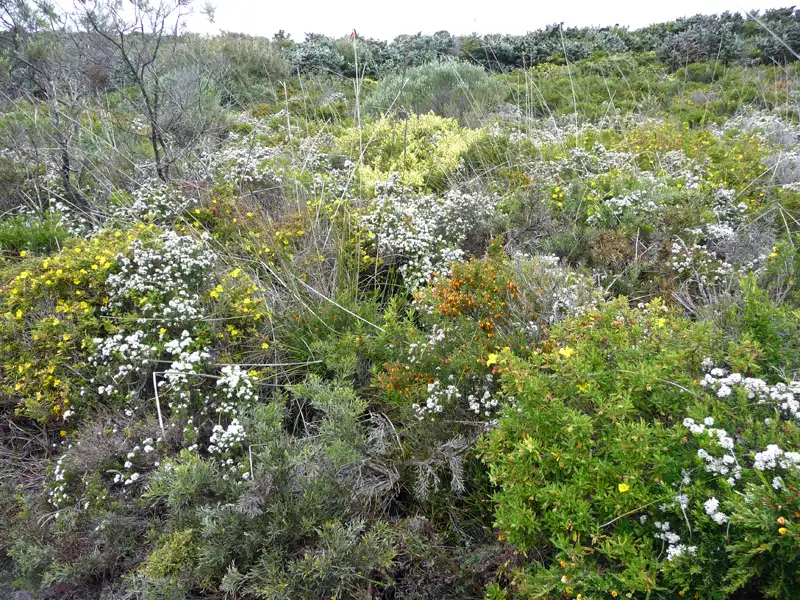
Along the Albany Wind Farm Loop, we found wildflowers in every imaginable colour, shape and size.
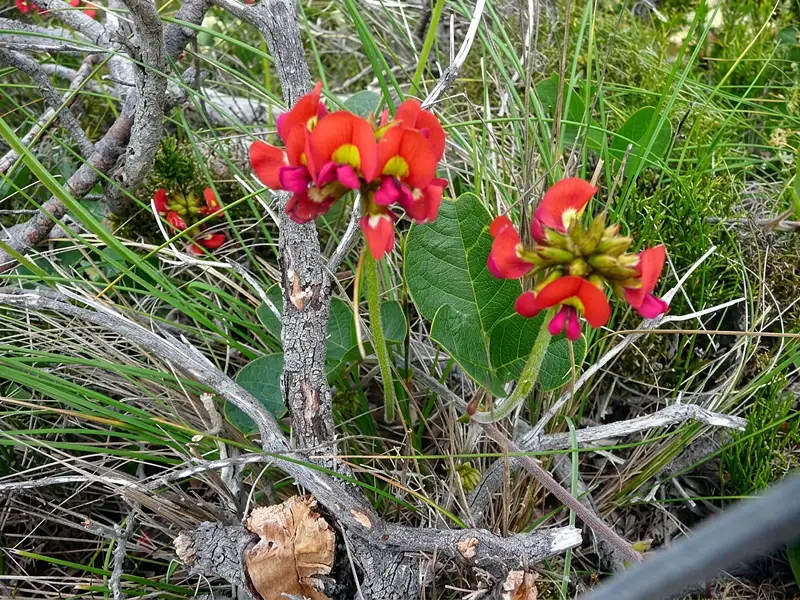
Along the Albany Wind Farm Loop another strinking wildflower – Heart-leaf Flame Pea (Chorizema cordatum) ?
Bremer Bay Wildflower Walk
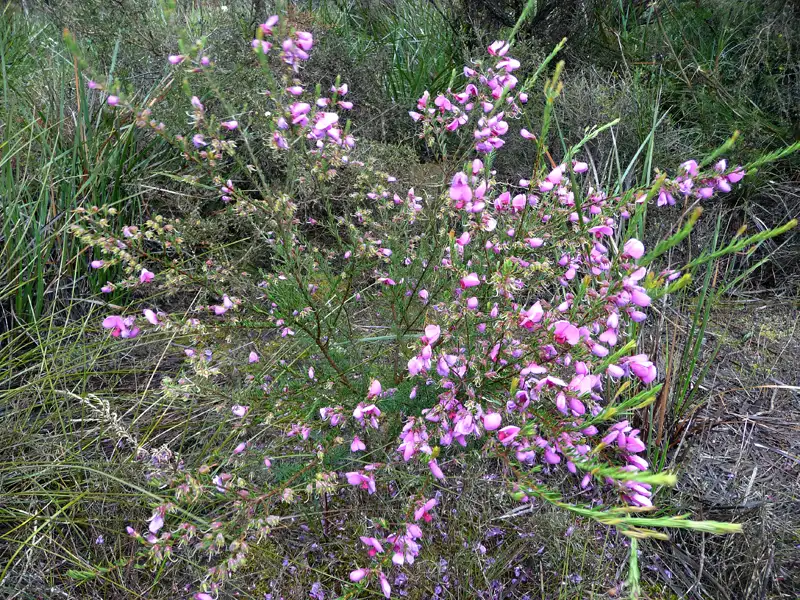
Poison peas or poison bushes (Gastrolobium) a beautiful shrub but high toxic livestock and pets

Cottonhead( Conostylis) common to the south-west region of Western Australia.
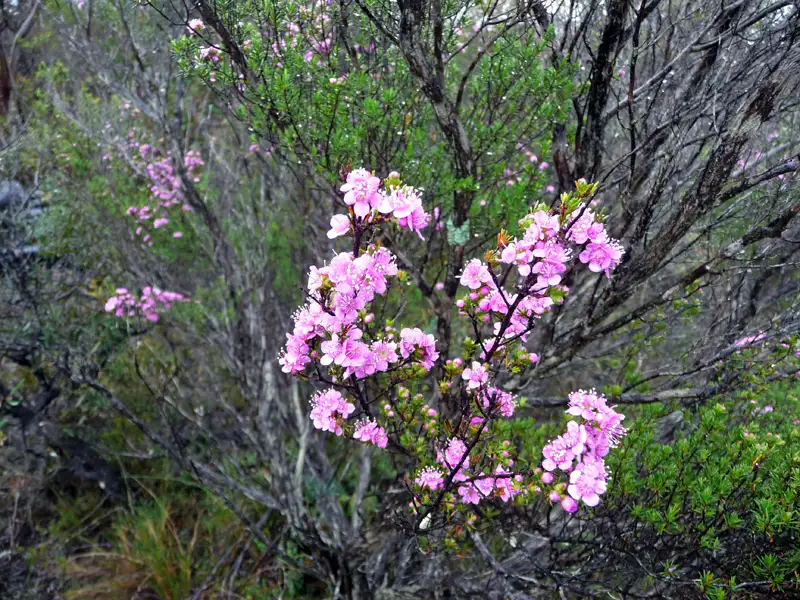
This pink-flowering native shrub is a Kunzea from the myrtle family (Myrtaceae).
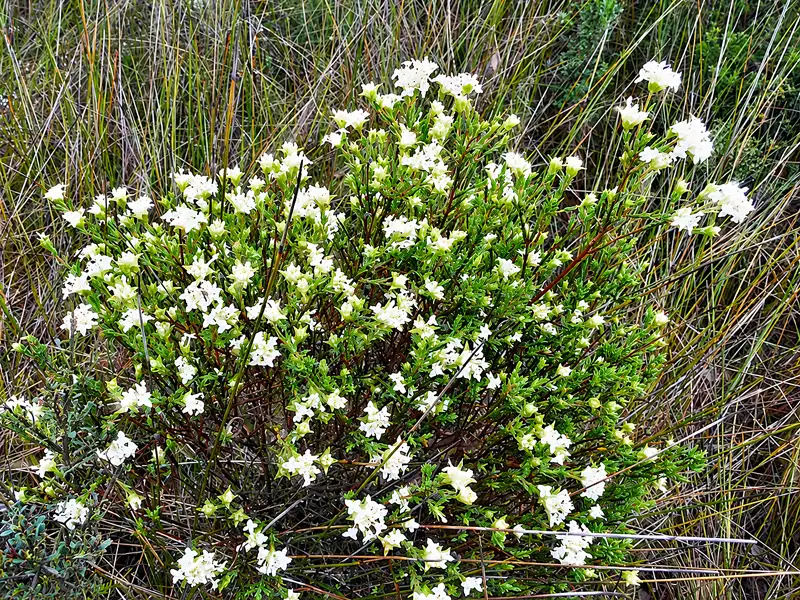
Short-leaf Riceflower (Pimelea brevifolia).
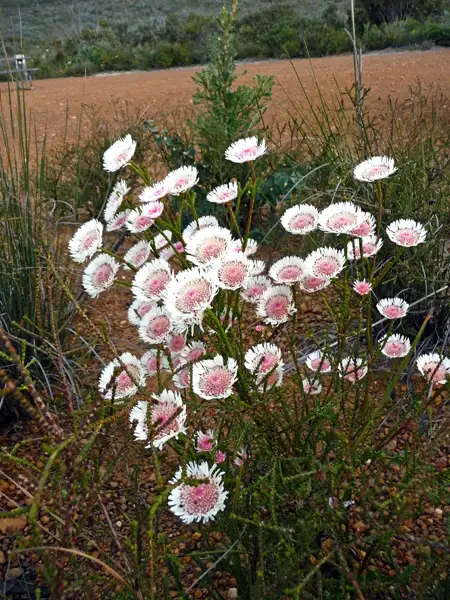
Swamp daisy or Albany daisy, despite its names and daisy-like look, it is not a true daisy; it belongs to myrtle family,

Rose coneflower (Isopogon formosus)

Splendid spider orchid or splendid white spider orchid (Caladenia splendens)
Point Ann, Whales & Wildflowers
Our next destination after Bremer Bay was Quaalup Homestead, on the western side of Fitzgerald River National Park. The evening before we headed off, we received an unexpected phone call from Karin, who owns Quaalup with her husband, Carsten. They were planning a trip to Point Ann and kindly invited us to join their tour.
We were delighted by the invitation and met Karin at the entrance to Fitzgerald River National Park. The road to Point Ann was closed to private vehicles because of the risk of dieback disease, but the National Park had a small minibus available to take visitors into the park. Before entering, we all had to carefully wash and disinfect our shoes to help prevent the spread of the disease.
The road was unsealed, rough and certainly not suitable for our motorhome. For us, this turned out to be a lucky break. Instead of trying to tackle the road ourselves, we could simply sit back, enjoy the ride and explore a part of Fitzgerald River National Park that we otherwise would have missed.
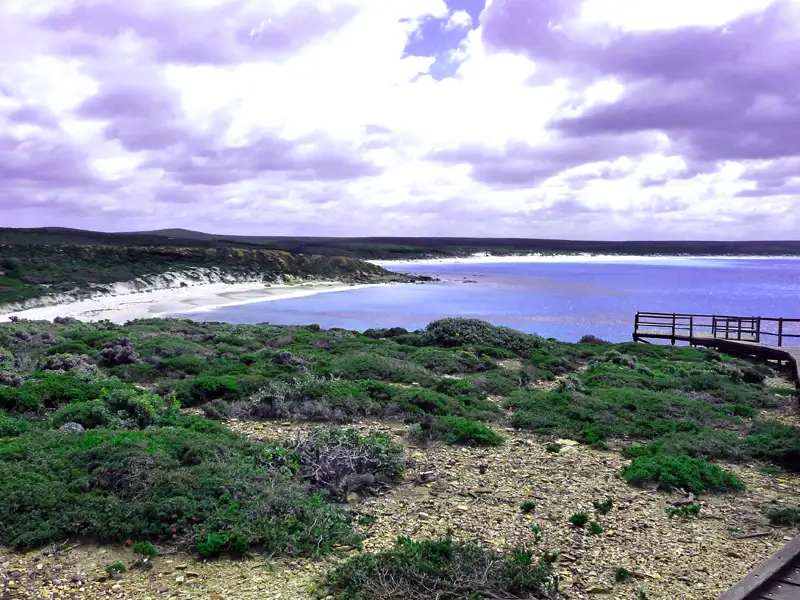
The tour was marvellous, with only six guests, and for us the rough road was part of the fun. One of the highlights was the Point Ann whale-watching platforms, with sweeping views across Point Charles Bay towards the Barren Range.
From June to the end of October, southern right whales commonly come close to shore here to calve and nurse their young.
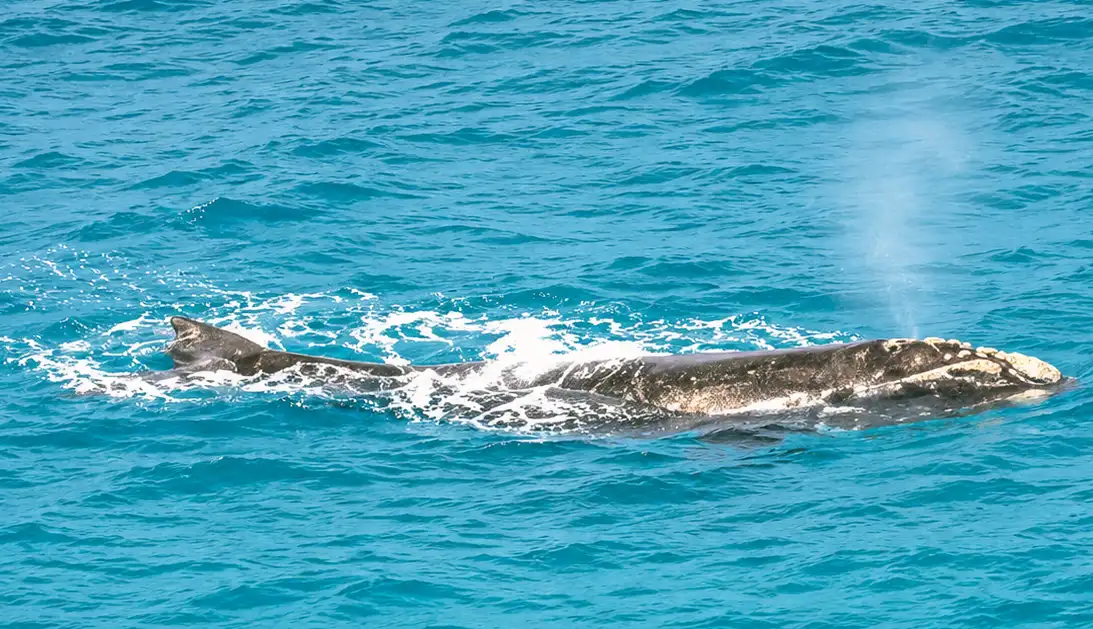
We were lucky to arrive at Point Ann at just the right moment. Although it was late in the whale-watching season, a southern right whale appeared surprisingly close to shore.
We watched quietly as it glided through the clear blue water, its enormous back breaking the surface before it disappeared again. Every now and then, it surfaced with a gentle blow, leaving a fine mist hanging above the water.

After our exciting whale-watching experience, we set off on the Point Ann Heritage Trail, an easy 1.5-kilometre walk following part of the original Rabbit-Proof Fence.
The trail was a delight from the beginning. Alongside the historic fence line, we had superb views across Point Charles Bay, while the surrounding bushland was bursting with wildflowers. For us, it was almost impossible to keep walking without stopping to admire another flower, shrub or colourful little plant.
The trail turned into a wonderful wildflower walk, and we took plenty of photos along the way. Here are some of the flowers we discovered.
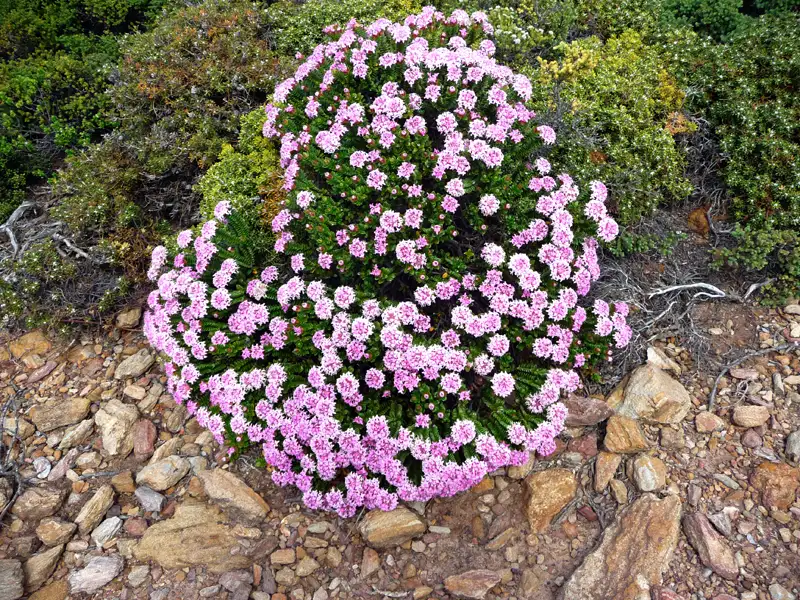
Pink rice flower (Pimelea ferruginea)
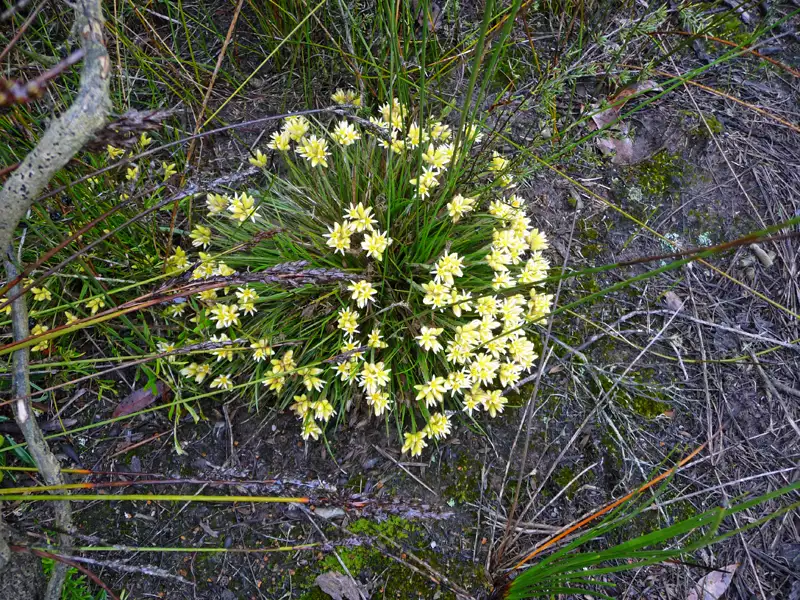
Conostylis pusilla a perennial grass-like plant
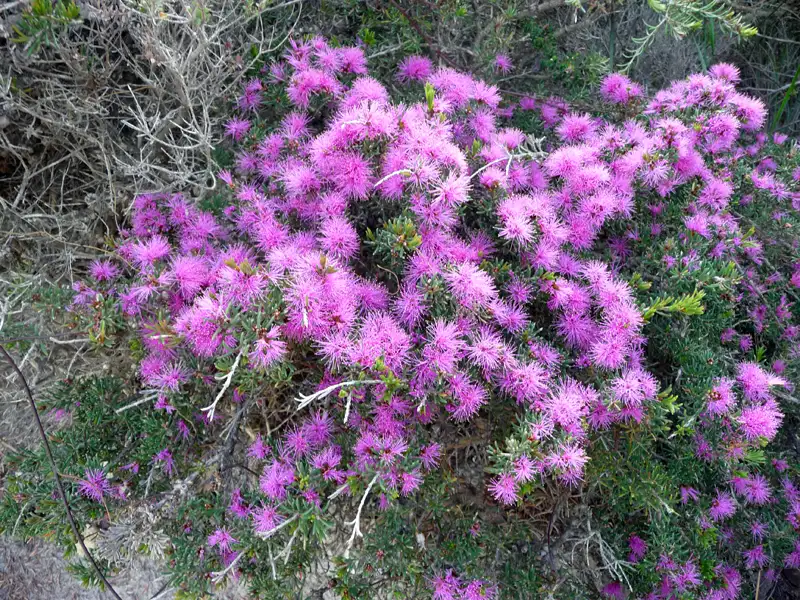
Pom-Pom Honey Myrtle (Melaleuca spathulata)
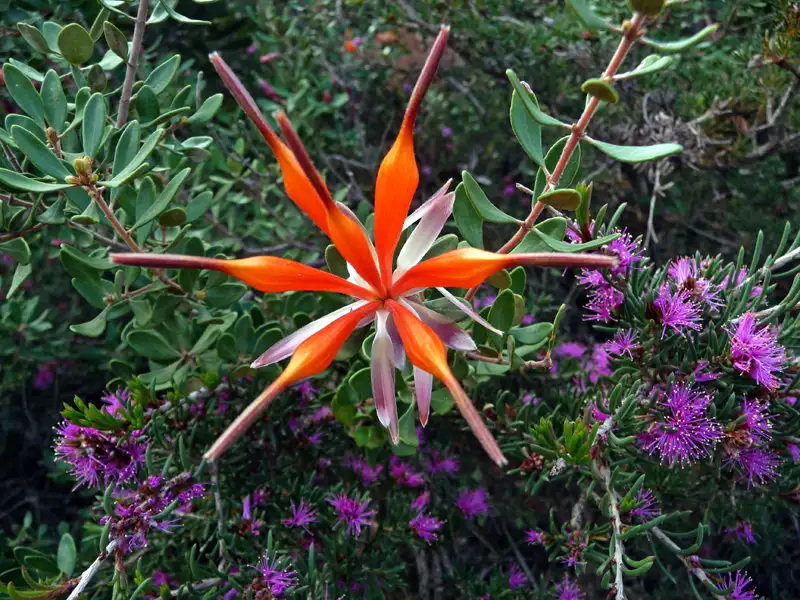
The Noongar Chittick (Lambertia inermis) is certainly one of the contenders for the title of prettiest flowering shrub. Its spectacular, star-shaped flowers seem to explode from the green foliage, with brilliant orange and red petals surrounded by delicate pinkish bracts. Against the purple flowers of the surrounding heath, the colours were simply stunning. Growing along Western Australia’s southwest coast from Albany to Esperance, it was one of the most striking wildflowers we discovered on our trip.
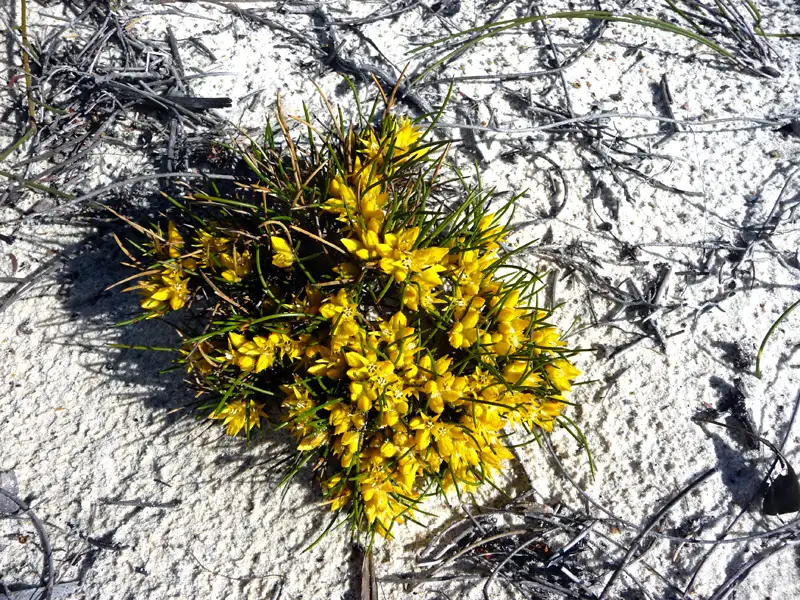
Another Cottonheads (Conostylis)
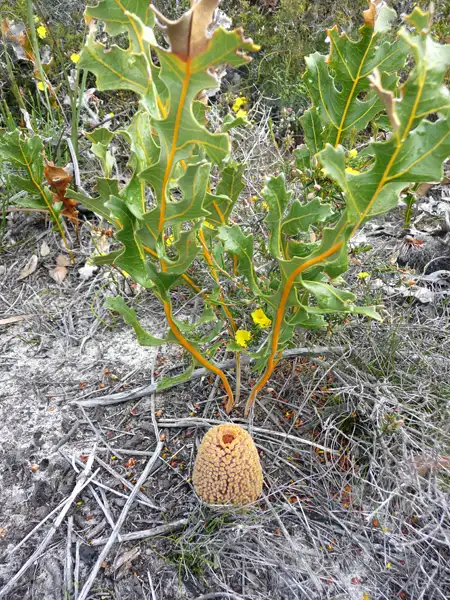
Creeping Banksia (Banksia repens)
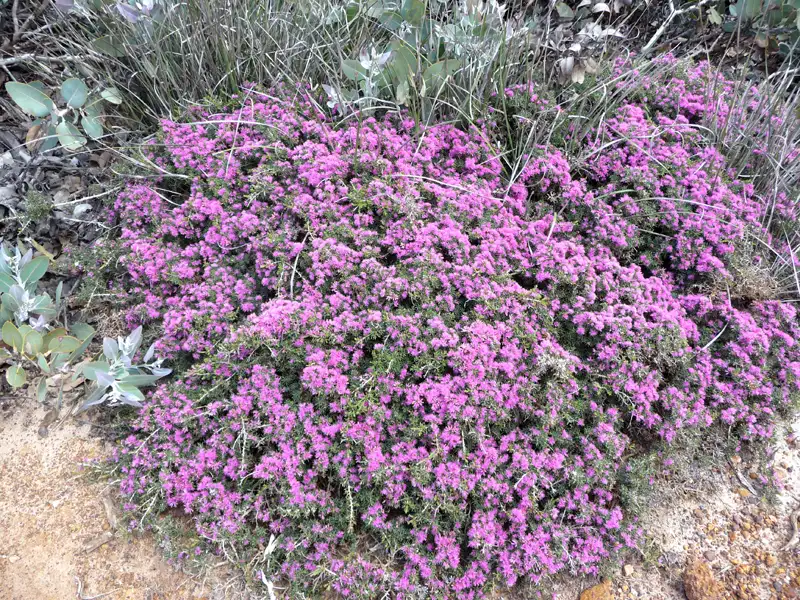
Featherflower (Verticordia)
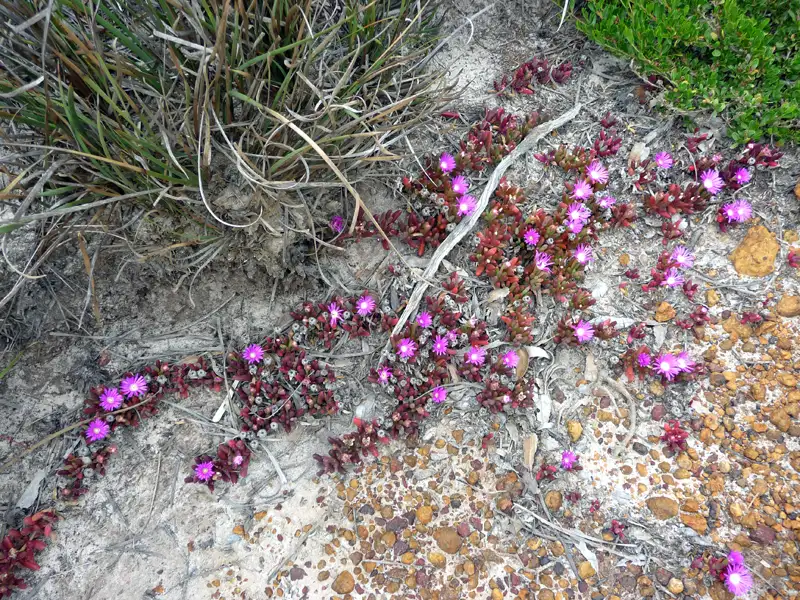
Round-leaf Pigface – Round Noonflower (Disphyma crassifolium subsp. clavellatum)

Smokebush (Conospermum)
Quaalup Homestead: Staying in Fitzgerald River National Park
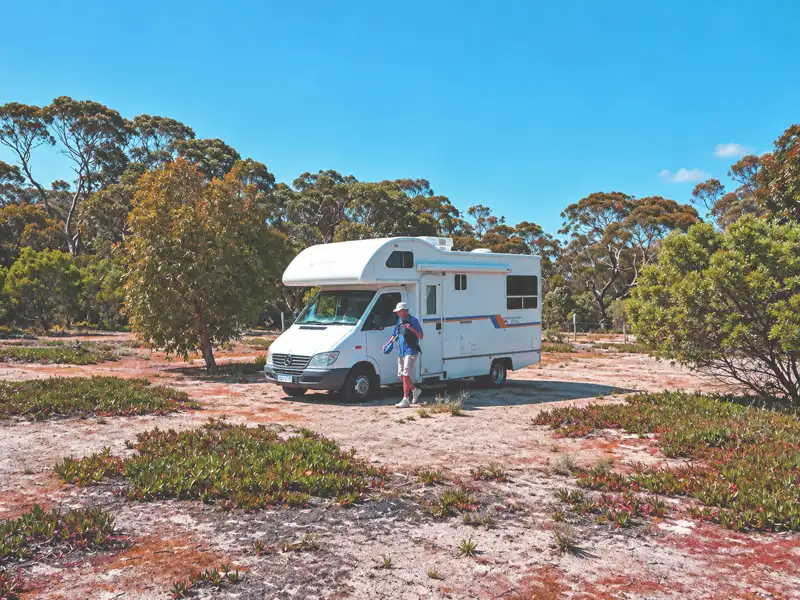
Quaalup Homestead Wilderness Retreat is a true hidden gem, nestled in 40 acres of pristine bushland in Fitzgerald River National Park. The owners, Karin and Carsten, are warm and welcoming and share a real passion for nature.We spent several wonderful, peaceful days at the retreat. With much of Fitzgerald River National Park closed because of dieback disease, there were very few visitors — wonderful for us, but difficult for the owners.
Karin and Carsten had created a lovely signed flower trail on their property, and with so many wildflowers around us, we couldn’t stop taking photographs. We enjoyed every minute of our stay and the hospitality of our wonderful hosts.
This was the southernmost point of our journey. From here, it was a 520-kilometre drive back to Perth — unfortunately a little faster than we would have liked, as we didn’t want to miss our flight home.
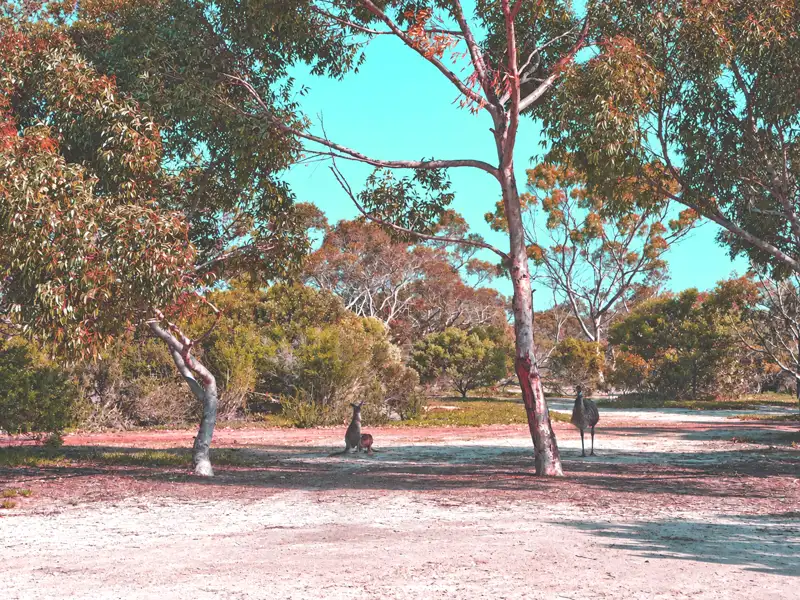
Some of our fellow campers at the campground: kangaroos and emus!
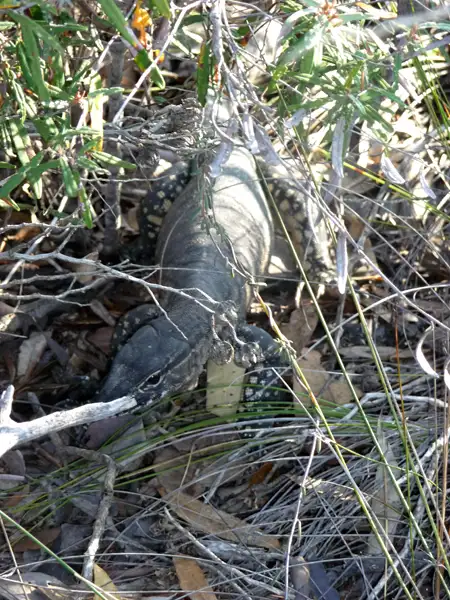
And a Lace Monitor
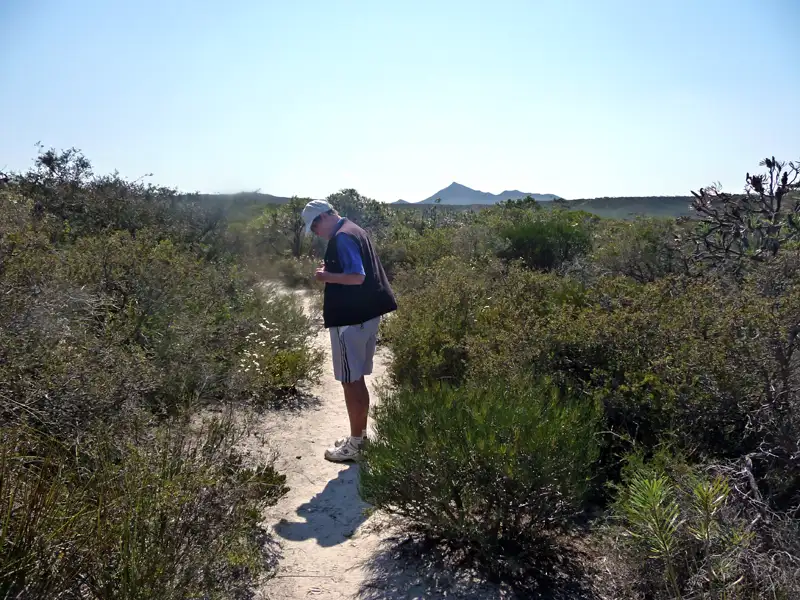
We loved being able to explore the many wildflower walks around Quaalup without even having to drive. Every walk seemed to reveal another beautiful flower or little surprise, and we could simply wander at our own pace and enjoy the peaceful surroundings. In the distance, West Mount Barren provided a spectacular backdrop, making these walks some of our favourite moments at Quaalup.
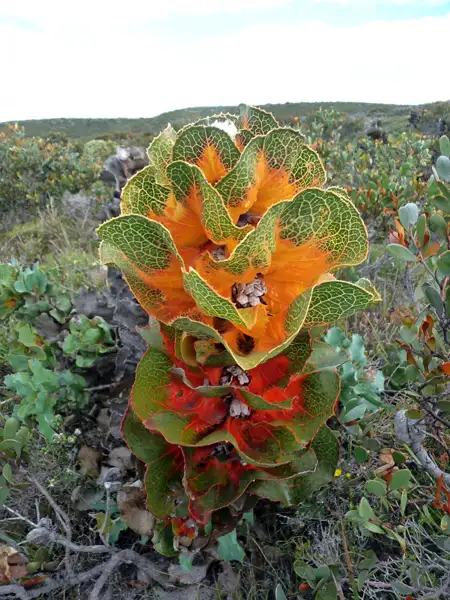
While staying at the Quaalup Homestead, we spotted the Royal Hakea (Hakea victoria). What a stunning plant! Its large, intricately patterned leaves, combined with the vivid orange and red flowers, make it unlike any other wildflower we had seen on our travels. Growing among the low heath of Fitzgerald River National Park, it was a particularly memorable find.
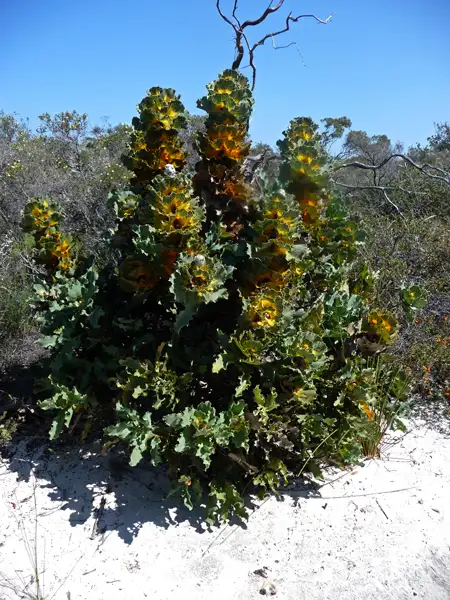
Royal Hakea (Hakea victoria)
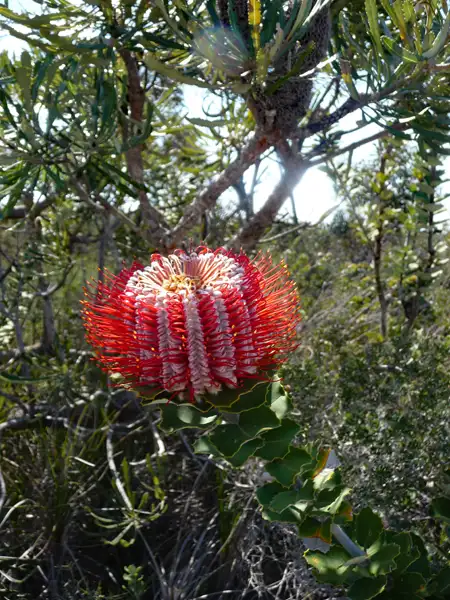
We spotted three Scarlet Banksias, also known as Waratah Banksia or Albany Banksia (Banksia coccinea), at Quaalup. With their striking red and orange flowers, they were among the prettiest flowering shrubs we had ever seen on our travels.
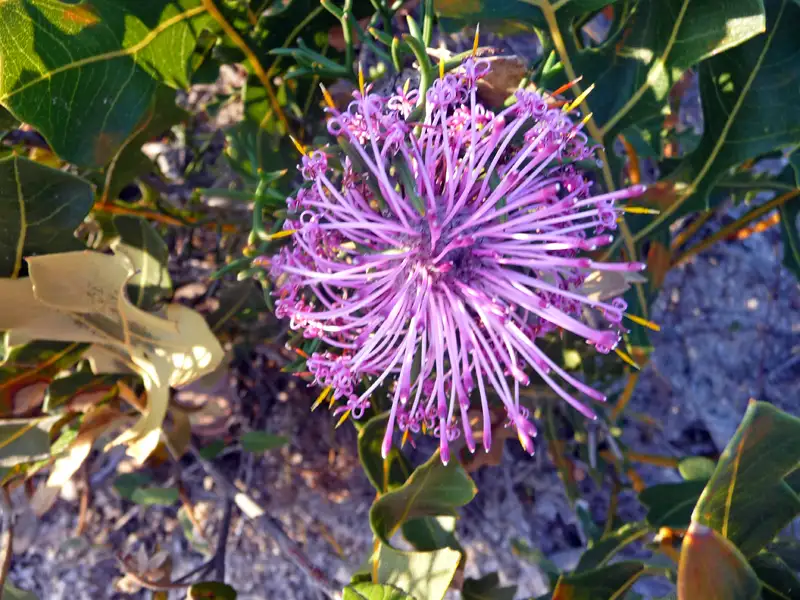
Pincushion coneflower (Isopogon dubius)
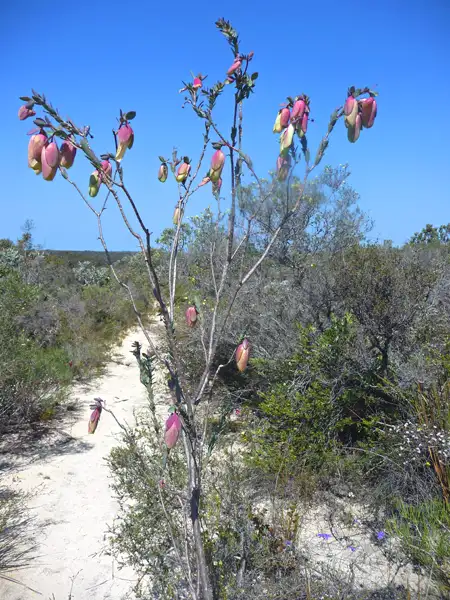
Qualup Bell (Pimelea physodes) flowering, Fitzgerald N.P., Western Australia
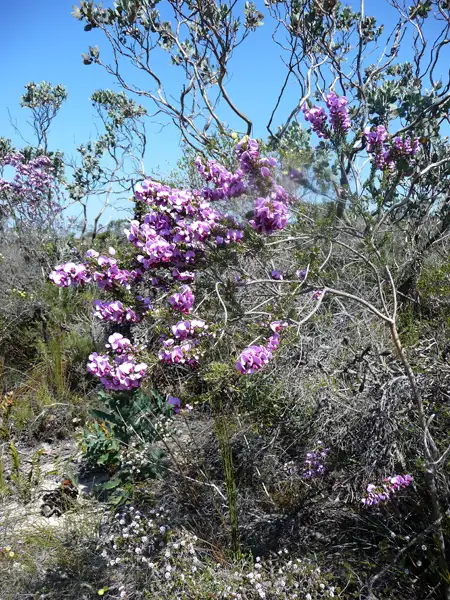
Painted Lady Legume (Gompholobium scabrum), a native Australian shrub, belongs to the pea and legume family
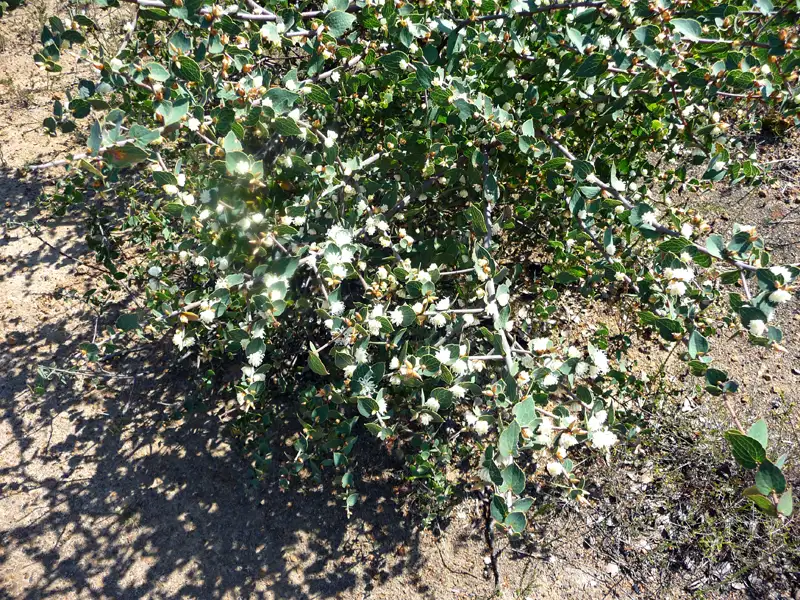
Rusty hakea (Hakea ferruginea)
Porongurup – Twin Creeks Conservation Reserve
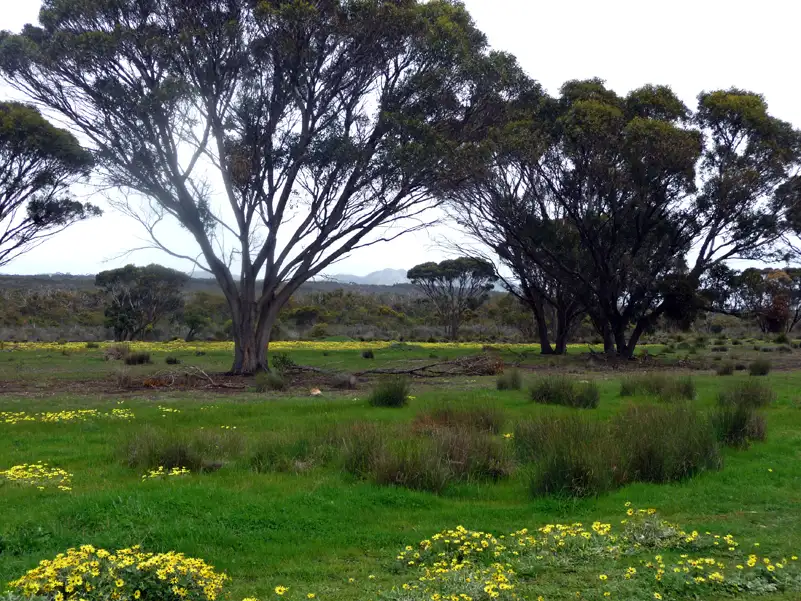
While staying in Porongurup, we visited Twin Creeks Conservation Reserve, a privately owned conservation reserve managed by the Friends of the Porongurup Range. The group purchased the 511-hectare former farming property and has been restoring it to its natural state.
We enjoyed walking the trails through the reserve and discovering the many wildflowers along the way. What impressed us most was seeing how the landscape has changed—from an old farm paddock to a lush green habitat filled with native flowers. The photograph below captures this wonderful transformation.
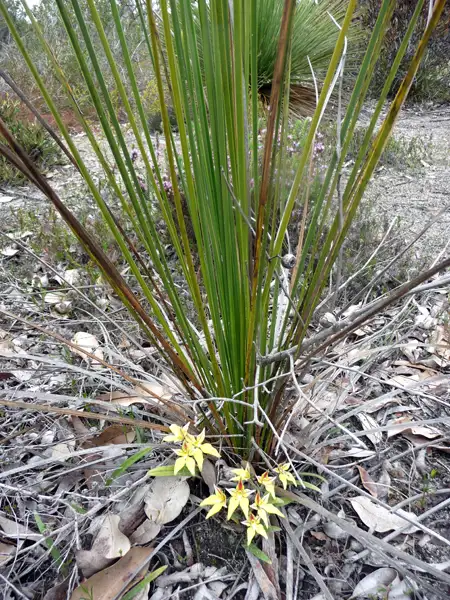
Cowslip orchid in Twin Creeks Conservation Reserve
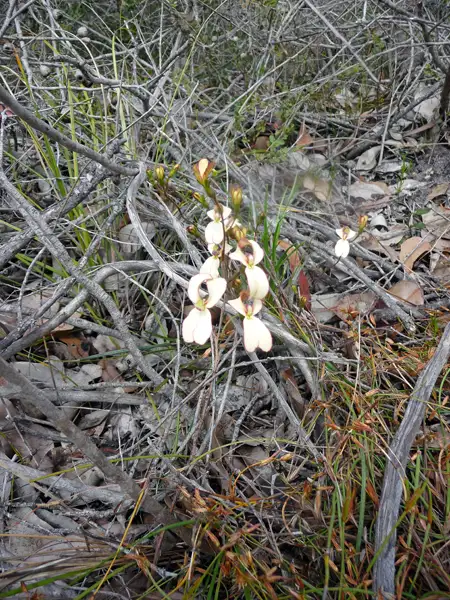
Cow Kicks trigger plant (Stylidium schoenoides)
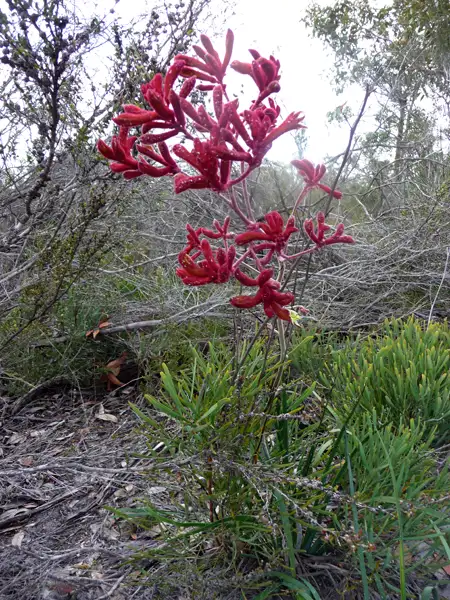
Red kangaroo paw (Anigozanthos rufus)
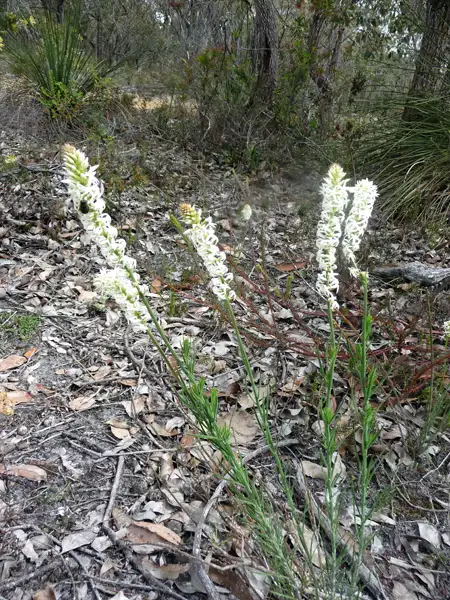
Creamy candles or bush candles (Stackhousia monogyna)
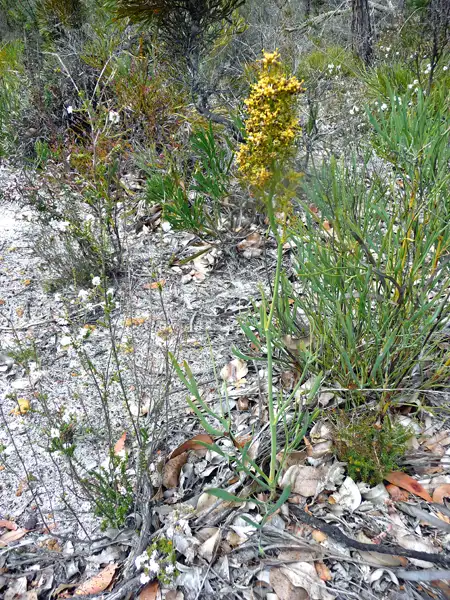
Among the wildflowers along the track, we came across Blueboy (Stirlingia latifolia). The name made us curious because its delicate flowers are actually yellowish, not blue. The unusual name goes back to early builders, who noticed that sand containing the plant’s roots could turn plaster or cement blue. A rather surprising name for such a pretty little plant!
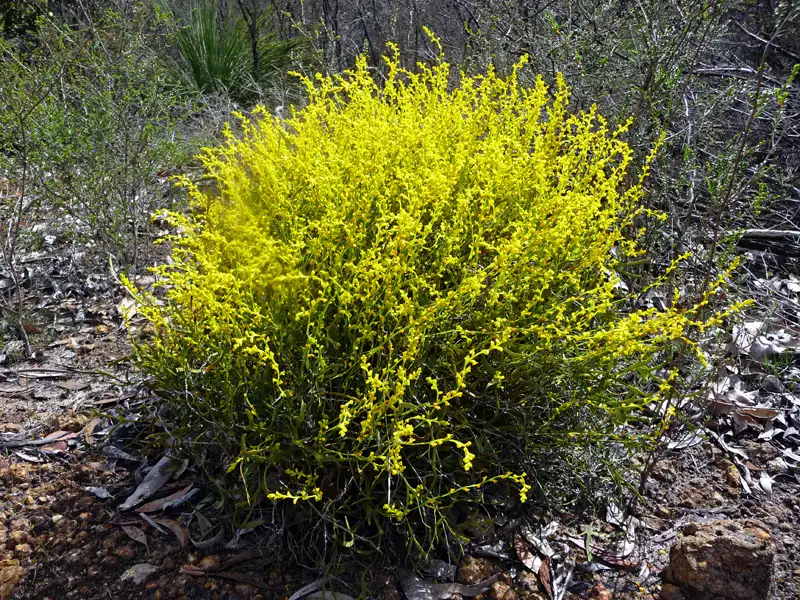
Stunning yellow Acacia – Wattle in South West WA.
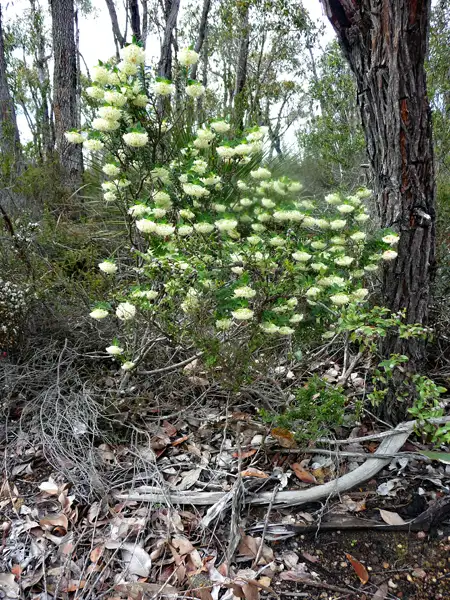
Dungyn (Hakea oleifolia), ? not sure the leaves are a bit rounder
Stirling Range National Park
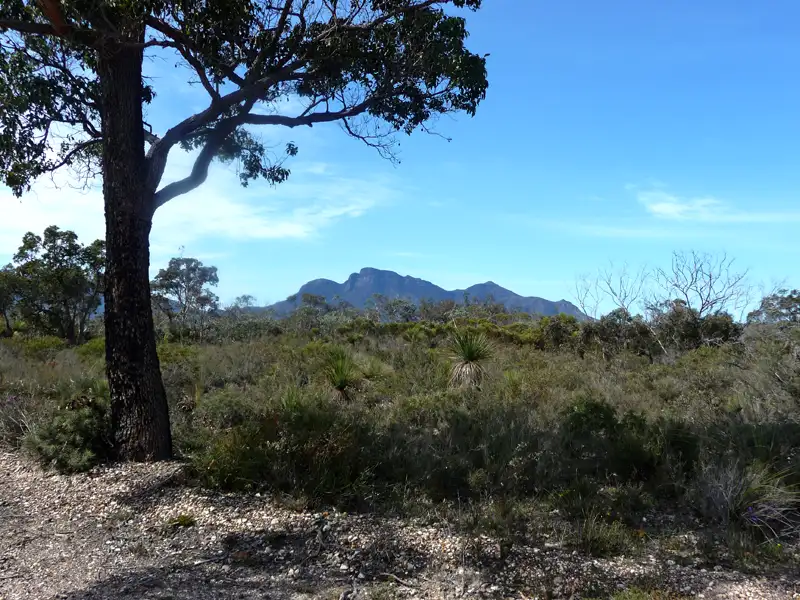
After Porongurup, we drove on to the Stirling Range Retreat, where we spent a couple of nights with our motorhome surrounded by the spectacular mountains of Stirling Range National Park.
The Stirling Range is a paradise for wildflower lovers, with more than 700 species of flowering plants, many of them found nowhere else. During our walk on Mount Trio, we were lucky enough to find the beautiful Mountain Bell (Darwinia oxylepis), one of the special plants that makes this region so unique.
We really enjoyed the peaceful setting of the retreat and its wonderful panoramic views across the mountains. During our stay, we did several walks, exploring the landscape and, of course, keeping our eyes open for more wildflowers.
We decided not to tackle Mount Bluff, which rises to more than 1,000 metres, and instead chose Mount Trio, at 856 metres. It may be lower and the walk shorter, but it certainly wasn’t easy! The track climbs very steeply, making us work hard for every metre of elevation. But the effort was rewarded with magnificent views over the Stirling Range and plenty of wildflowers along the way.
Wildflower Bonanza
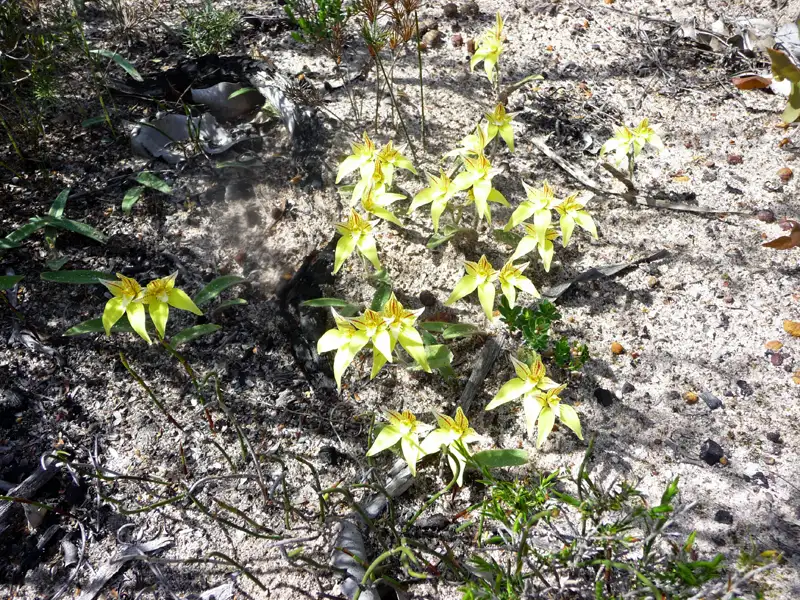
Cowslip orchid (Caladenia flava)
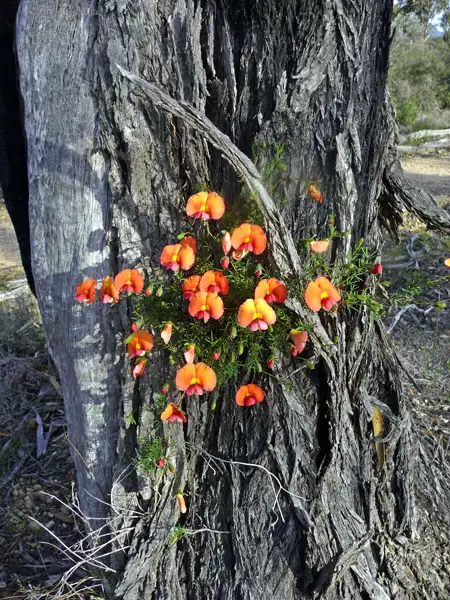
Climbing wedge-pea (Gompholobium polymorphum) , scrambling up the rough bark of a tree
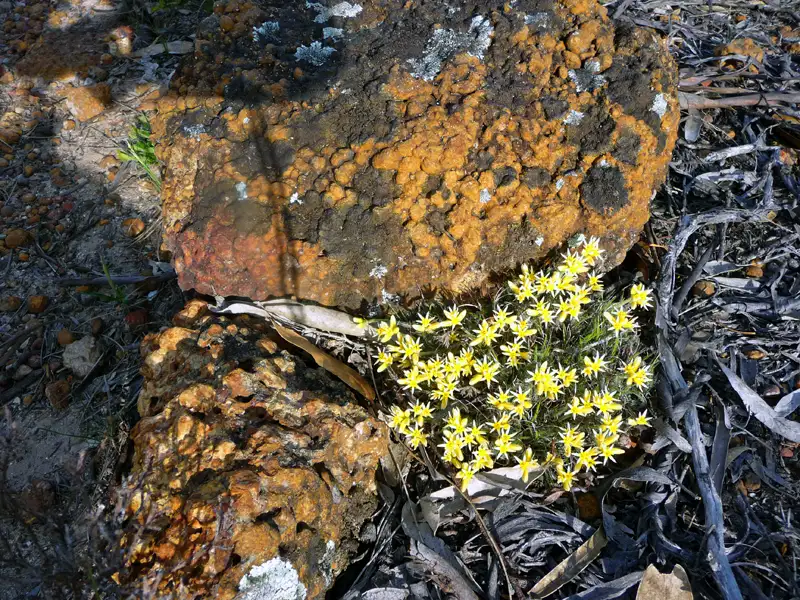
Cottonheads (Conostylis)
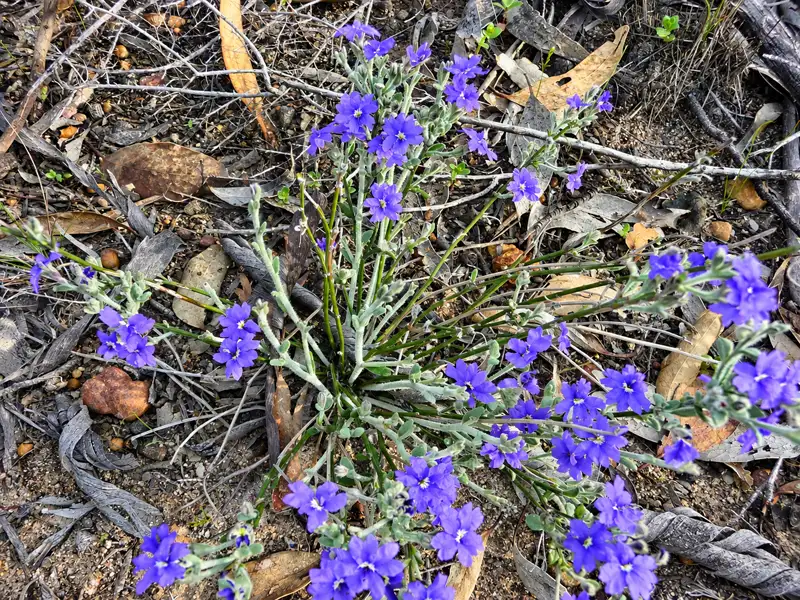
Blue Dampiera (Dampiera loranthifolia
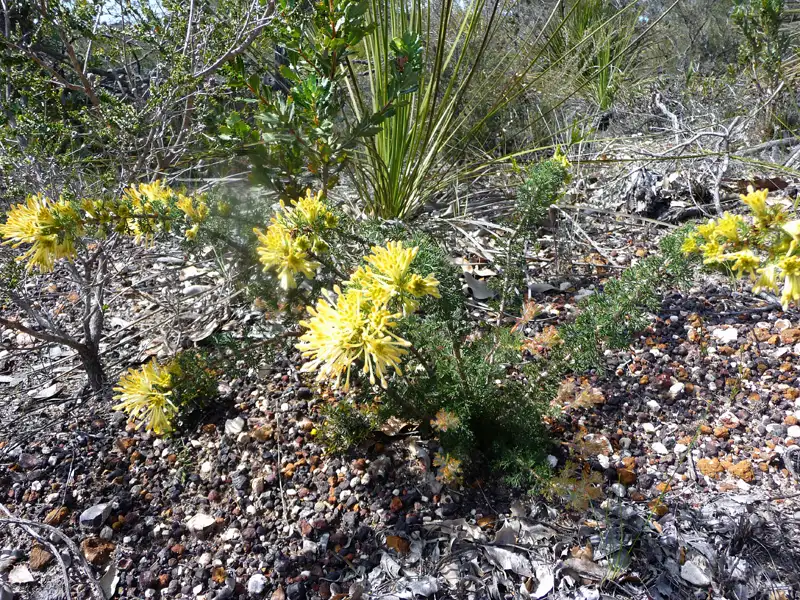
Tangled Petrophile (Petrophile divaricata)
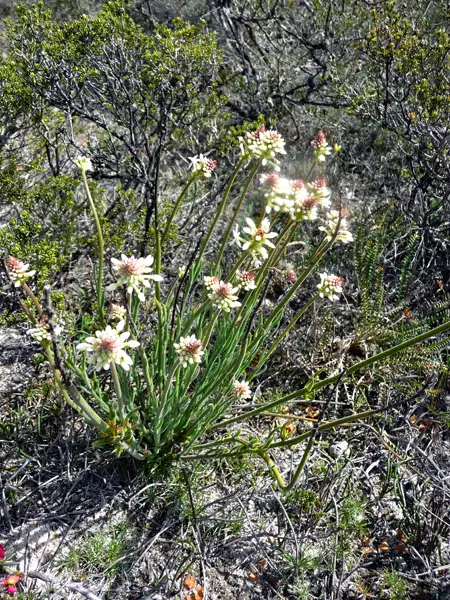
Paper Lilly (laxmannia squarrosa)
Mount Trio – A Steep Walk with Wonderful Views
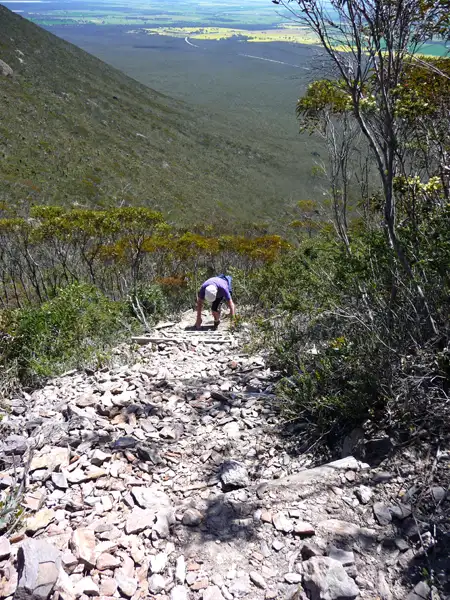
The hike to Mount Trio looked easy on paper—just 3.5 km return. Surely that should be manageable for two quite fit seniors like us! But we soon discovered that the distance doesn’t tell the whole story.
It is a Grade 4 walk, with a very steep climb of around 400 metres in a relatively short distance. You need strong legs and a heart that is still working nicely! The climb certainly made us work, but it was well worth the effort.
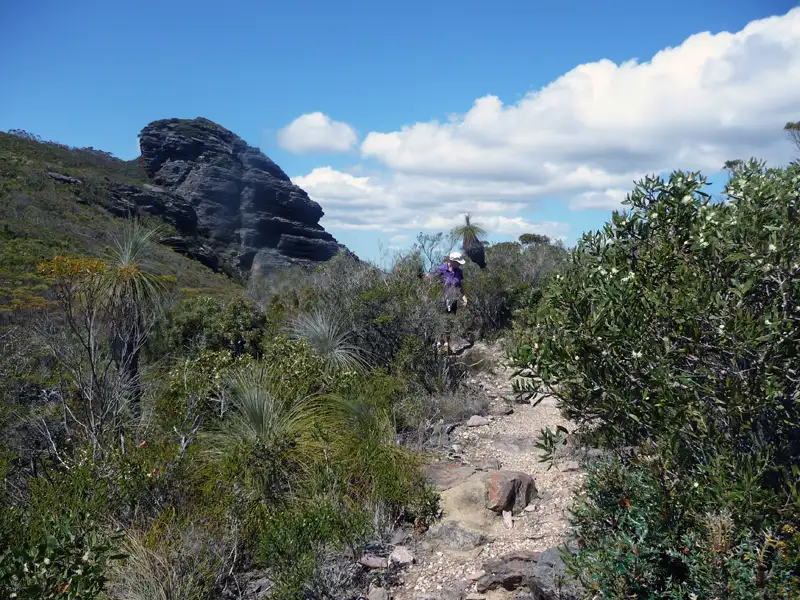
Walking along the ridge was a real pleasure, with wonderful views across the Stirling Range and beautiful native vegetation all around us.
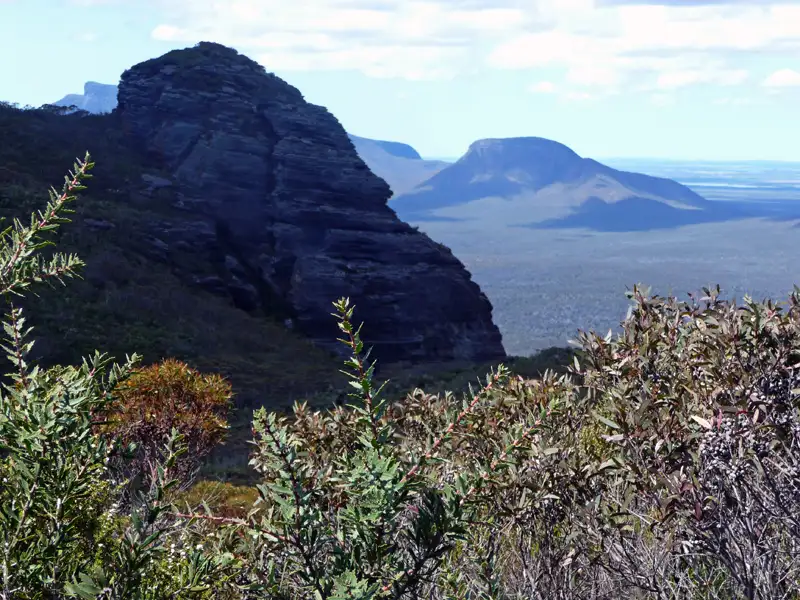
At the top, we were rewarded with wonderful panoramic views across the Stirling Range and beautiful native vegetation along the track. And then came another special reward: we discovered the bright red Mountain Bell (Darwinia lejostyla), a beautiful wildflower that grows only in the Stirling Range. For us, finding this little red flower made the steep climb even more worthwhile.
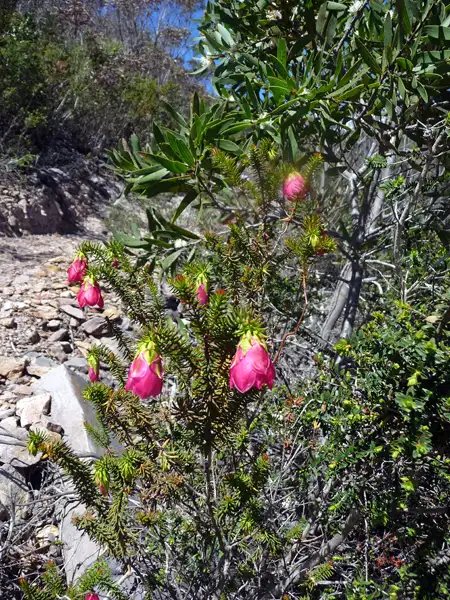
Mountain bell (such as Darwinia oxylepis)
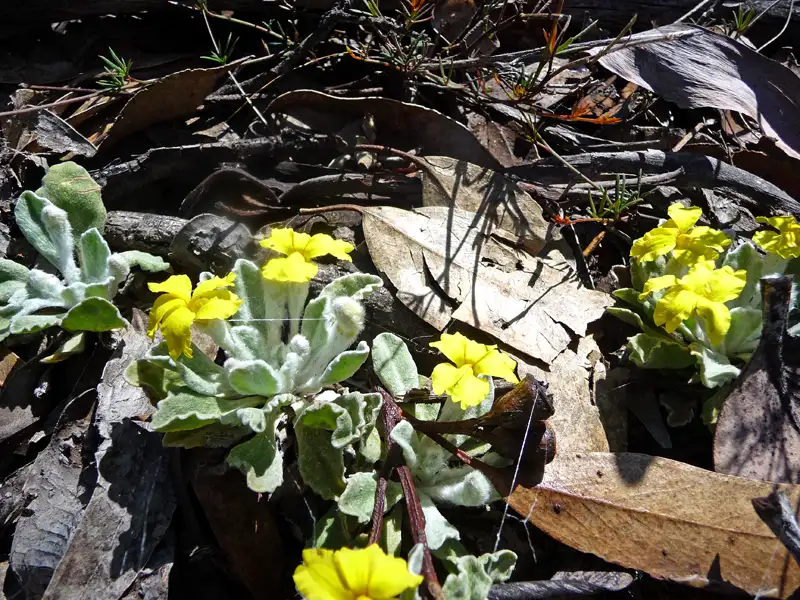
Silver goodenia (Goodenia affinis)
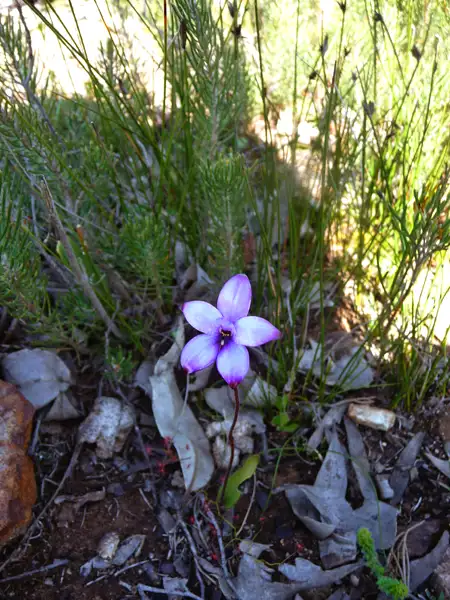
Purple enamel orchid (Elythranthera brunonis)
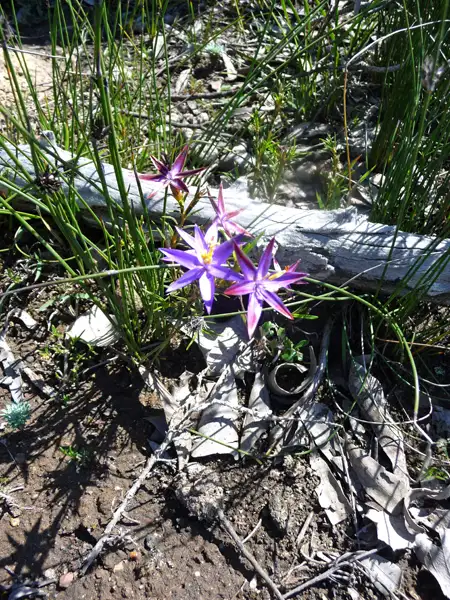
Blue tinsel lily ( Calectasia grandiflora)
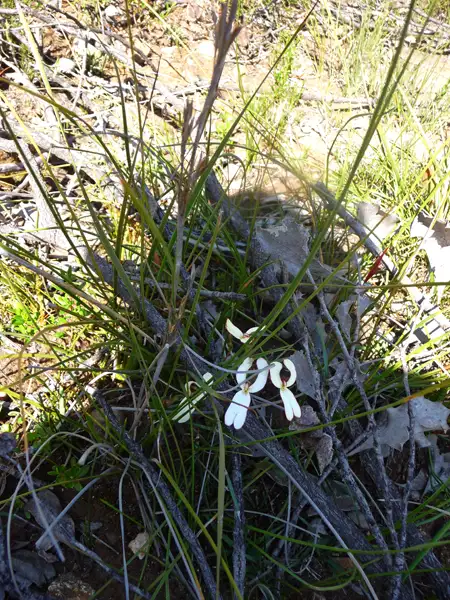
Cow Kick Triggerplant (Stylidium schoenoides)
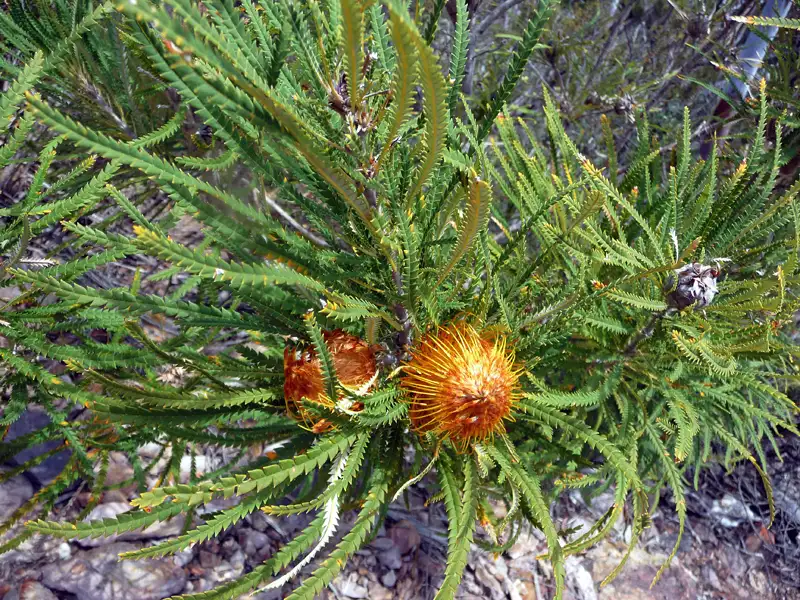
Showy Dryandra (Banksia formosa,
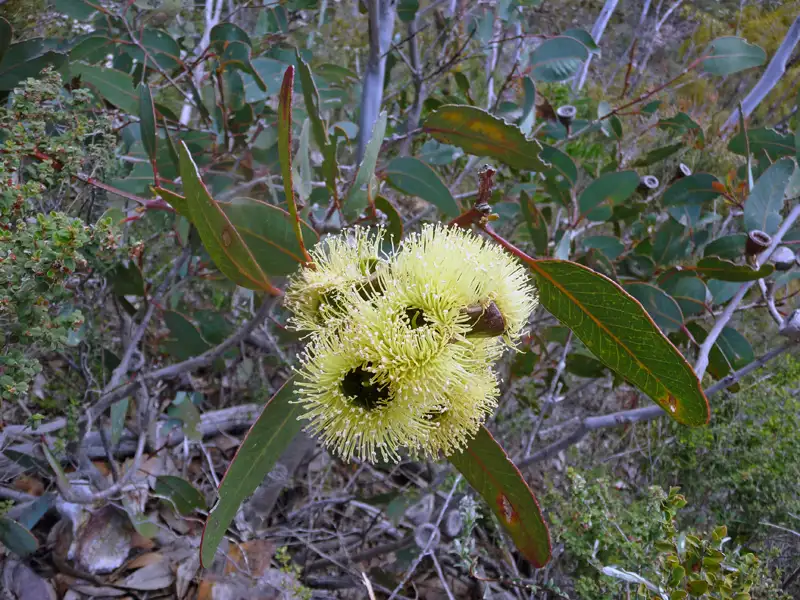
Bell-fruited Mallee (Eucalyptus preissiana)
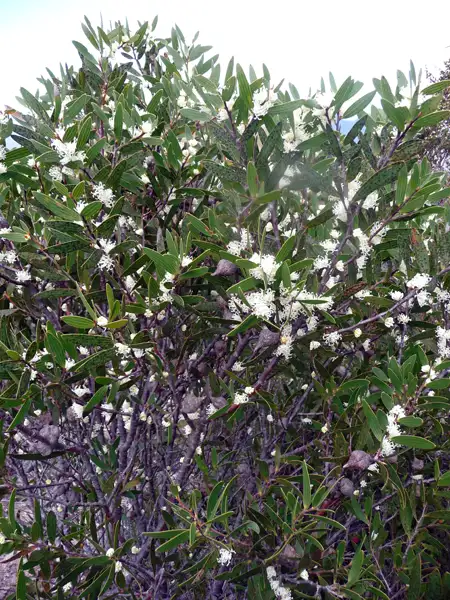
Hakea ambigua
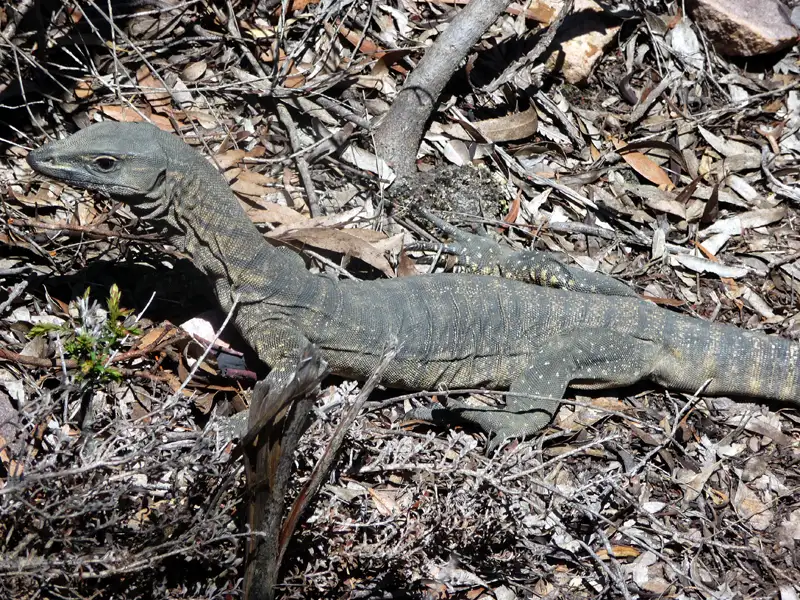
But the surprises weren’t over. On the way back, another highlight suddenly crossed our path—a 1.5-metre-long racehorse goanna, also known as a sand goanna, Gould’s monitor or bungarra. It was an impressive sight as this large lizard made its way across the track and disappeared into the bush.
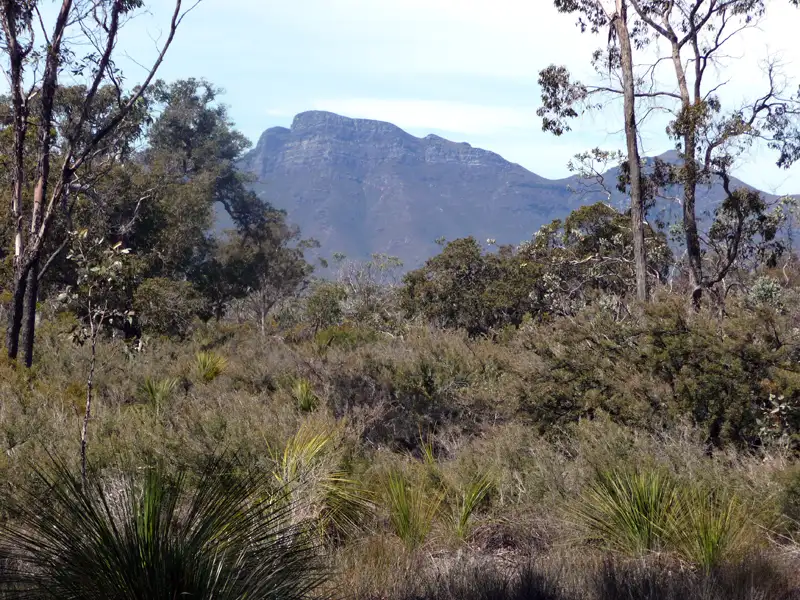
For us, the mountain views, wildflowers and unexpected wildlife encounters made the steep climb up Mount Trio well worth the effort.
After a short rest, we were back on the road, heading towards our next destination, Kojonup. As we left the Stirling Range behind, we took one last look at Knoll Peak – Pualaar Miial. Rising to 1,099 metres, it is the highest peak in the southern part of Western Australia.
Its impressive profile made a fitting final view of the Stirling Range—a beautiful mountain landscape that had been one of the highlights of our journey through Western Australia.
Kojonup a Wildflower Paradies
After our hike at Mount Trio, we drove to the small town of Kojonup, where we stayed for two days. Located in Western Australia’s South West, Kojonup is a wonderful destination for anyone interested in Western Australian wildflowers.
The Kojonup Visitor Centre, at 143 Albany Highway, was an excellent starting point. The friendly staff shared their local knowledge and provided maps and advice on where to find some of the area’s hidden wildflower gems.
We explored Farrar Dam Reserve and visited Myrtle Benn Flora and Fauna Sanctuary, searching for the beautiful white and red spider orchids. Everywhere we went, we found something worth stopping for and photographing, from delicate orchids to colourful native wildflowers.
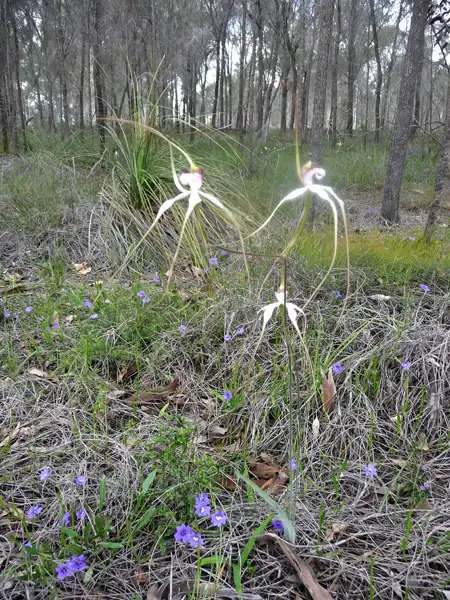
At the tourist office in Kojonup we also found lots of useful information about wildflowers and native orchids in Western Australia. Maps of where to find them and images to help us identify them. As a result, we found the Splendid Spider Orchid
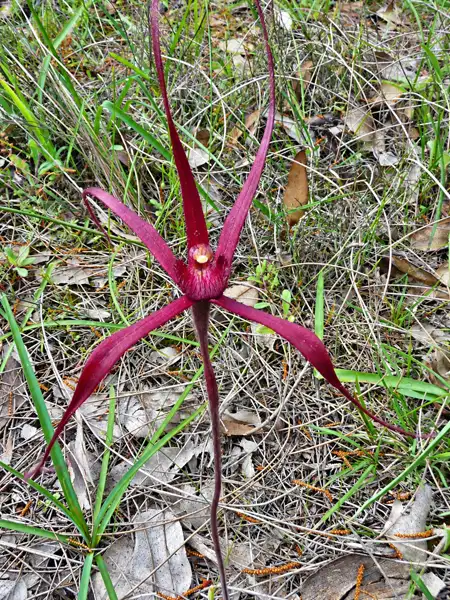
Blood spider orchid (Caladenia filifera)
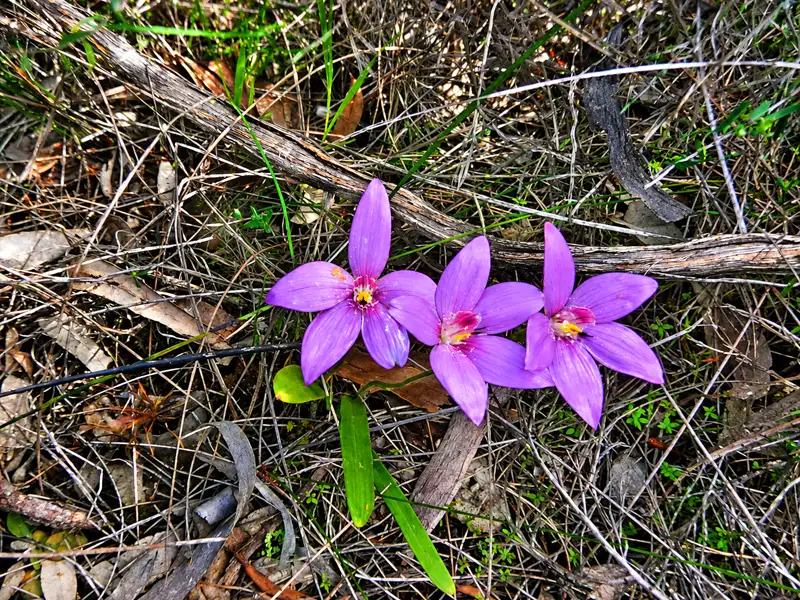
Purple enamel orchid (Elythranthera brunonis)
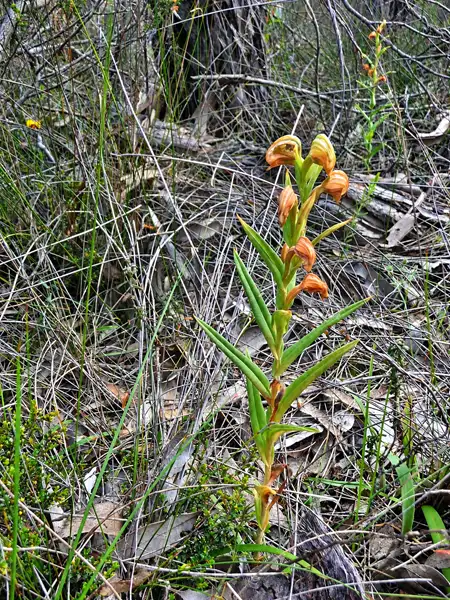
Banded greenhood[ (Pterostylis vittata) a plant in the orchid family, in flower
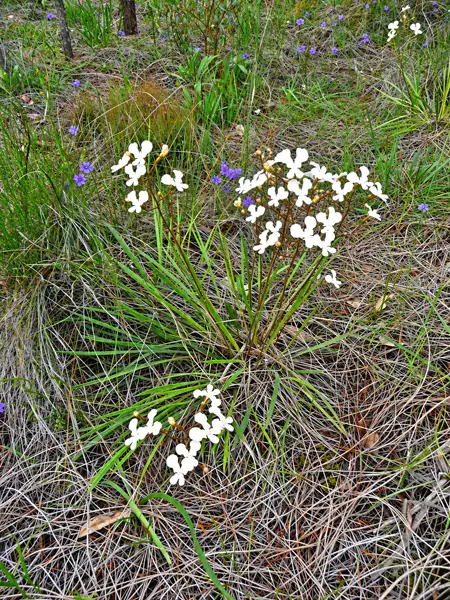
Cow Kicks – Cow trigger plant (Stylidium schoenoides)
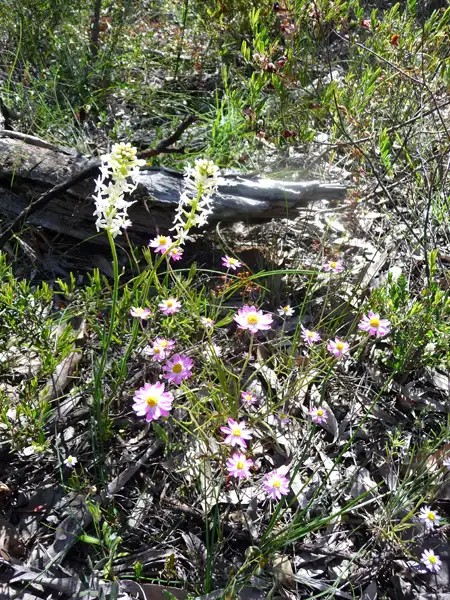
Creamy Candles (Stackhousia monogyna) alongside pink everlasting daisies

Catpaw (Anigozanthos humilis) is a member of the kangaroo paw family (Haemodoraceae). We also came across these colourful flowers at Quaalup Homestead and in the Porongurup Range.
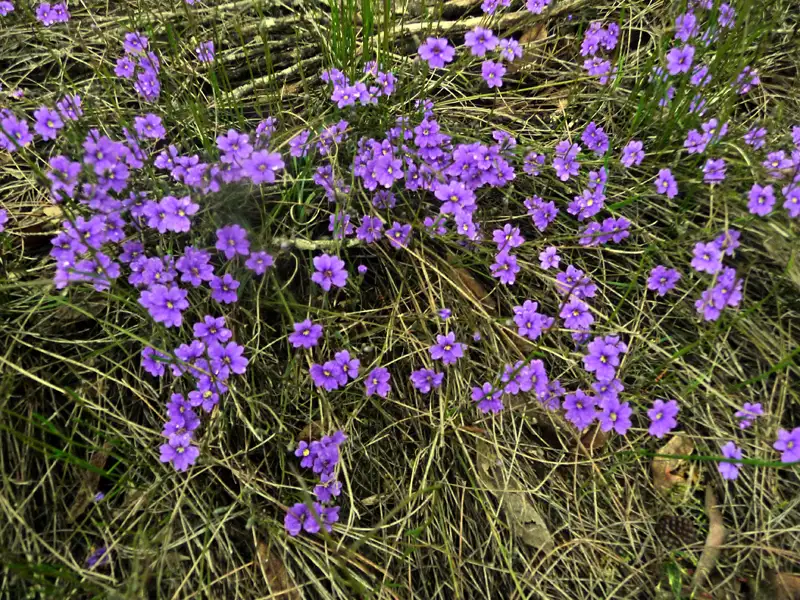
Dampiera (Goodeniaceae)
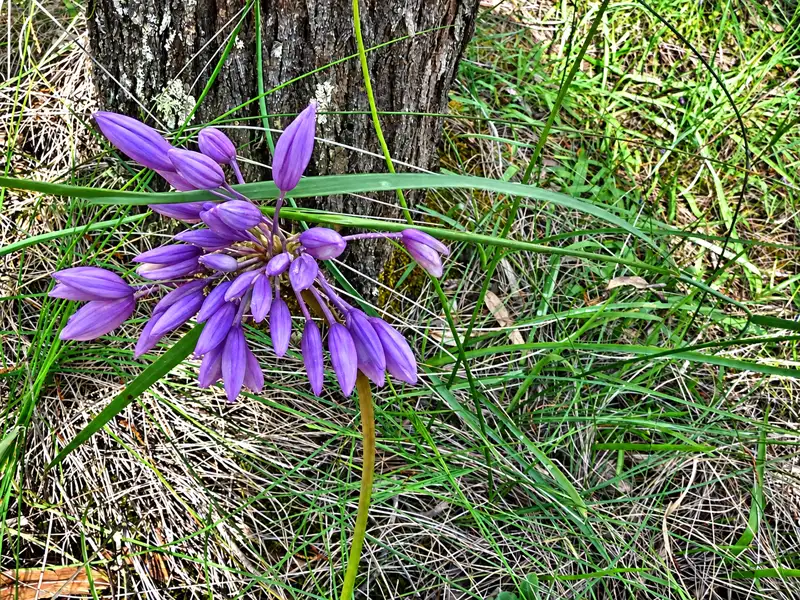
Purple Tassels (Sowerbaea laxiflora)
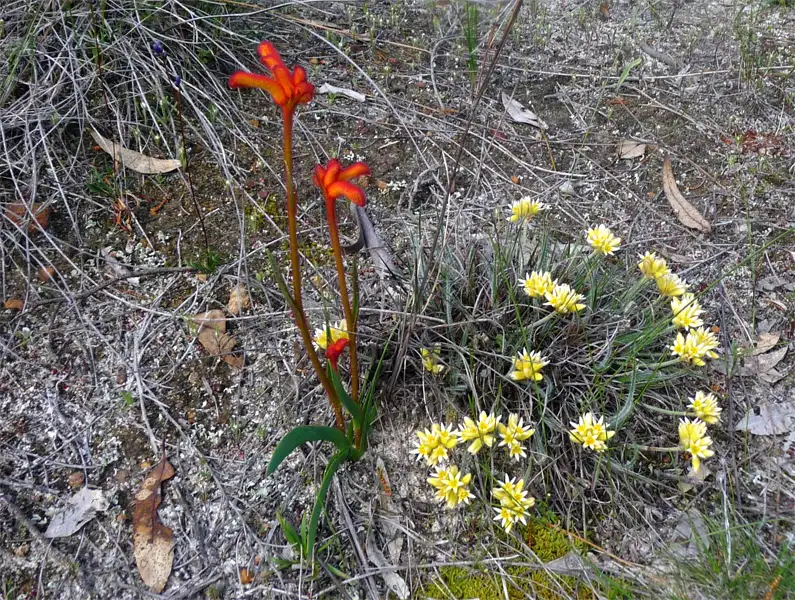
Catpaw and Bristly Cottonheads (Conostylis setigera)
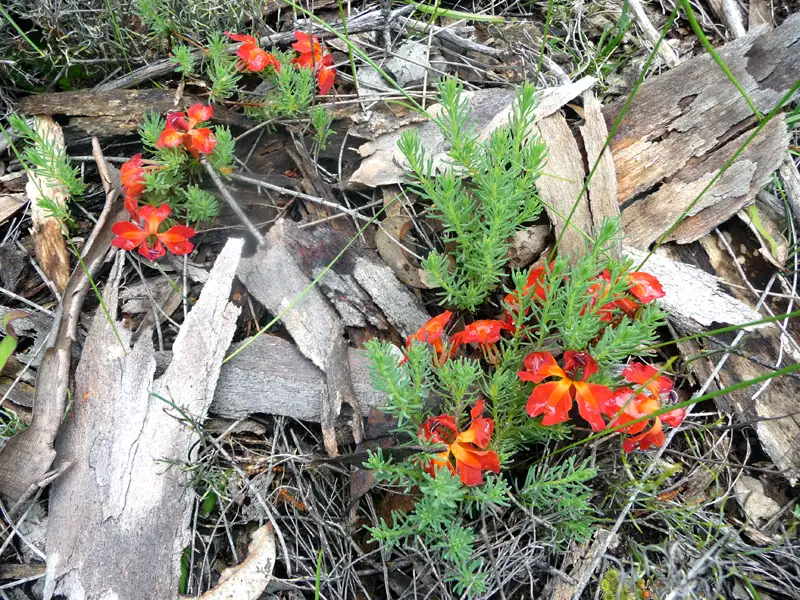
On the end of the day we found the Red Leschenaultia ((Lechenaultia formosa) Kojonup’s floral emblem
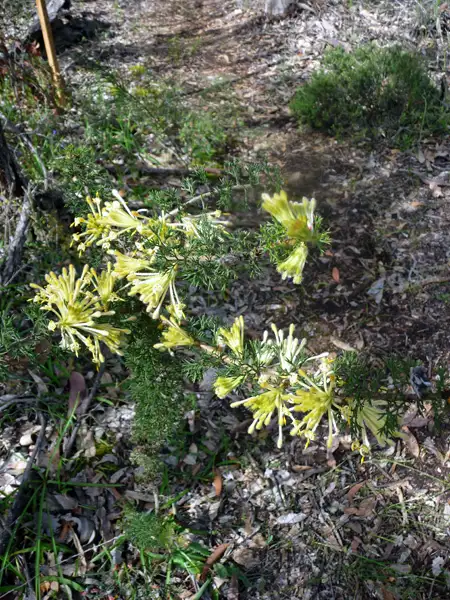
Petrophile serruriae

Prickly Conostylis, (Conostylis aculeata)
Back to Perth – Conclusion
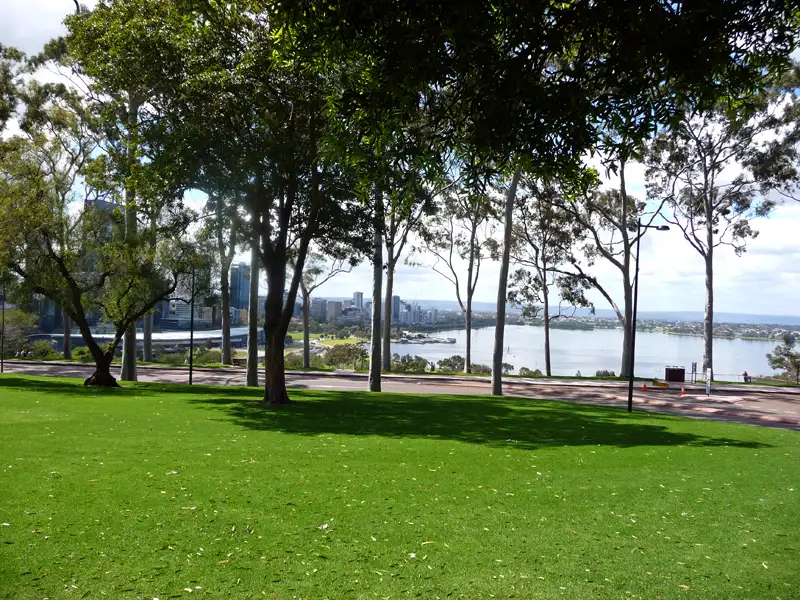
A walk in the wonderful Kings Park and Botanic Garden enjoying the city and water.
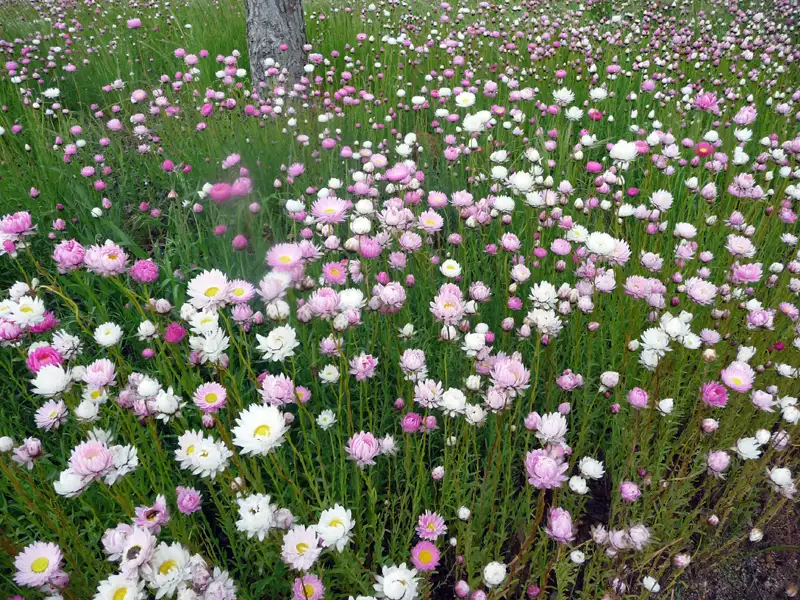
Pink and white everlasting daisies
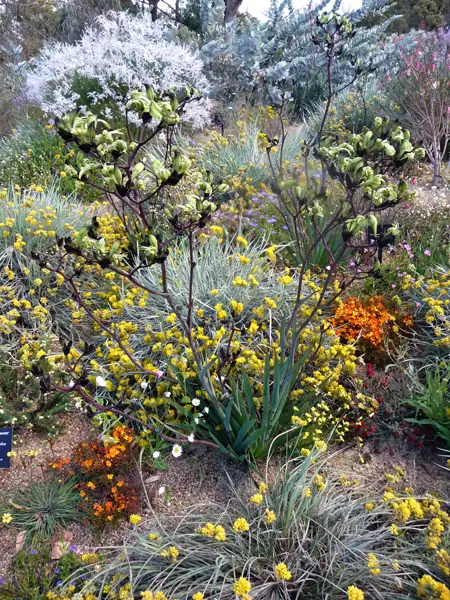
Black Kangaroo Paw (Macropidia fuliginosa)

Conclusion
We spent three weeks discovering the South West of Western Australia, and I think we chose just the right amount of time for the trip. We never felt rushed and had plenty of time to explore, go walking and enjoy the wildflowers without having to drive long distances from one place to another.
Hiring a motorhome was a great choice. We didn’t have to book campsites far in advance, there was no packing and unpacking, and we had our own kitchen wherever we stayed. Best of all, we could often spend the night in beautiful bush locations surrounded by nature. From time to time, we needed to stay in caravan parks to recharge the batteries, refill our water tank and empty the waste tanks, but that was a small price to pay for the freedom of travelling this way.
We were also lucky that the places we visited were never overcrowded. While August is generally considered a peak month for wildflowers, we chose September, which turned out to be an excellent time for orchids. We discovered an amazing variety of wildflowers, many of which we had never seen before.
As keen bushwalkers, we have always enjoyed learning about Australia’s native plants, but identifying so many unfamiliar species was a challenge in itself. With the help of Google Lens, ChatGPT, Gemini and comparisons with other photographs, we believe we identified around 90% of the plants and flowers correctly. The process taught us a great deal and added another rewarding dimension to our journey.
There was one notable exception to our orchid discoveries: the Queen of Sheba Orchid, which we didn’t manage to find.
Perhaps that gives us the perfect reason to return for another wildflower adventure in Western Australia.
More from Western Australia: Ningaloo Reef
More from Western Australia: Kimberley